
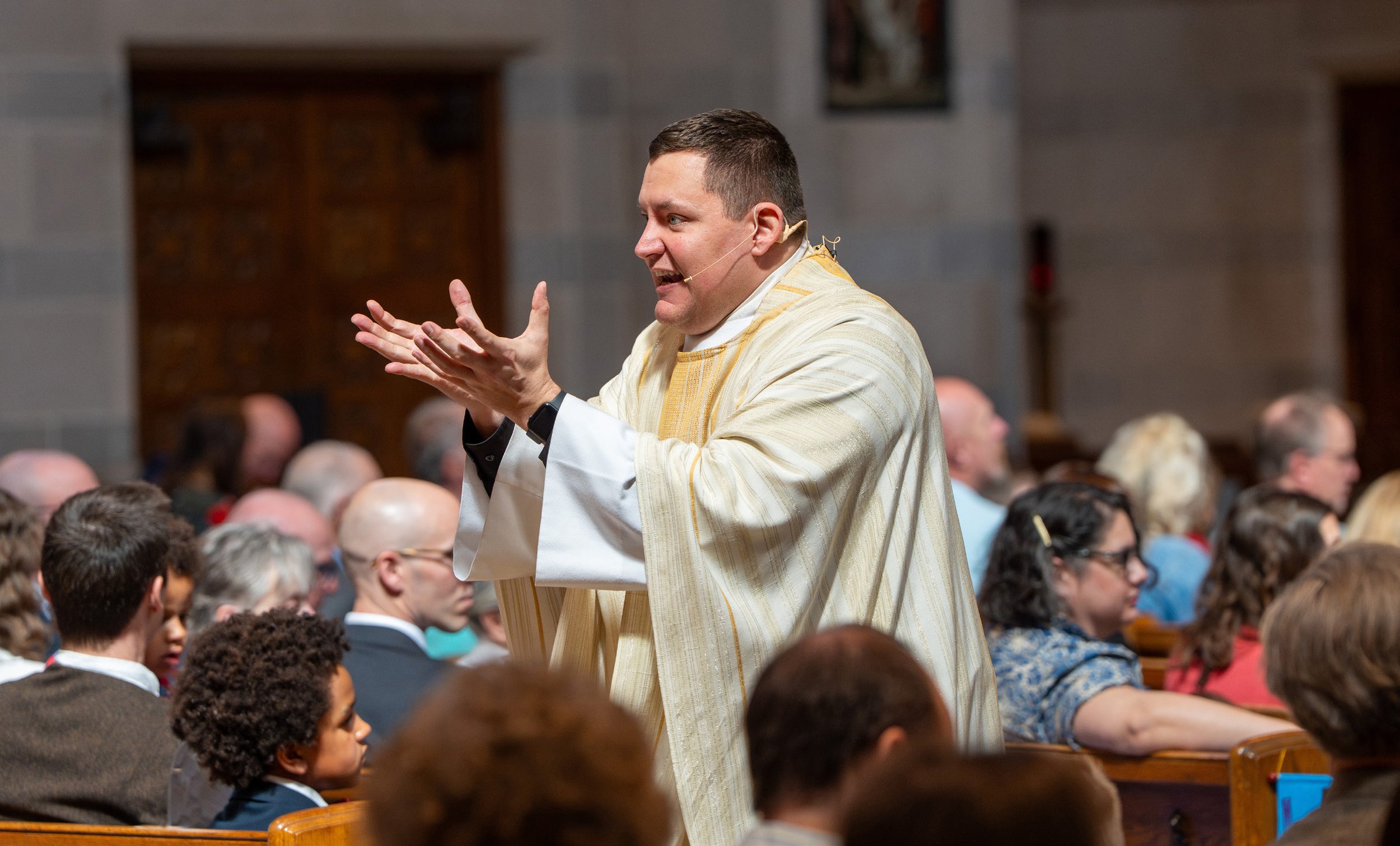
Father R.J. Fichtinger, SJ, delivers a homily at Saint Thomas More Catholic Community in St. Paul, Minn., the Jesuit parish of the Twin Cities.

Catholics are drawn to Jesuit parishes for their compelling homilies, invigorating spiritual practices, commitment to social justice and collaborative environments of thoughtful dialogue
By Patricia McGeever
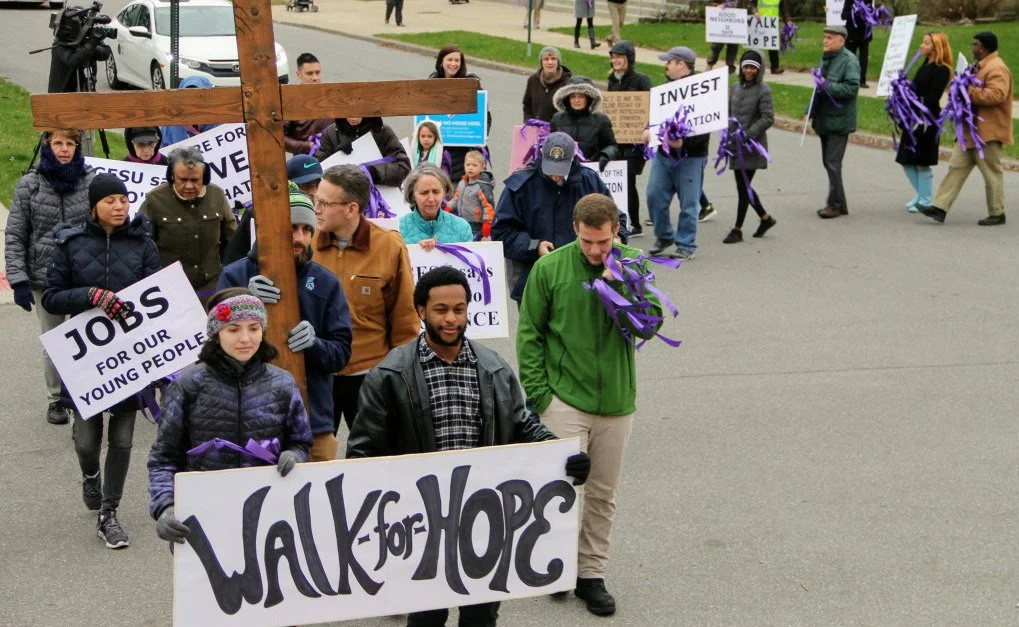
People are drawn to Jesuit parishes in part for their commitment to social justice. Here, parishioners at Detroit’s Gesu Catholic Church participate in a Walk for Hope.
Kieth Daniel drives 30 minutes from his home in Alexandria, Ky., to attend Mass at Bellarmine Chapel on the Xavier University campus in Cincinnati. A former United Methodist minister, he converted to Catholicism in 2022 and says he felt welcomed the first time entered the Jesuit chapel. He also loves the Jesuits’ commitment to lifelong learning, intellectual openness and dialogue.
“They have this willingness to engage with complex modern questions fostering thoughtful, critical yet faithful dialogue,” he says, and this is part of why he and many others, including Susan Neill, travel great distances to attend Mass at Jesuit parishes.
Neill sampled many churches before she chose St. Xavier Church in downtown Cincinnati, 40 miles from her home in Lebanon, Ohio.
“It’s nourishing my heart in a way that I can’t really put into words,” she says.
Bellarmine Chapel and St. Xavier have formed a Jesuit Parish Family as part of the Archdiocese of Cincinnati’s Beacons of Light restructuring process. Father Paul Lickteig, SJ, is pastor.
“We were very intentional about using our awareness of the Spiritual Exercises and how formative those are for our communities as kind of a cornerstone of what we were going to build together,” Fr. Lickteig says. “The biggest difficulty has been, how do you recognize that both of these parishes have a very distinct character and history, and the reason people go to each parish is because of that distinct character and history?”
Father Lickteig believes that people choose Jesuit parishes for preaching that is not only intellectually and theologically solid, but also spiritually invitational—preaching that attempts to meet people where they are.
PARISHES ARE NOT OUTDATED INSTITUTIONS. THEY ARE VITAL EXPRESSIONS AND SOURCES OF MISSION TO THE SOCIETY.
Jordan Skarr, the Midwest Province’s provincial assistant of pastoral ministries, says that in addition to offering liturgical and sacramental experiences, Jesuit parishes are committed to sharing Ignatian spirituality, promoting faith that does justice, and forming missionary disciples through a culture of evangelization.
“It’s such a privilege to experience the trust that bishops have in the Jesuits to help lead these parishes,” Skarr says. “Parish ministry is a key way the Society can be of service to the Church today.”
Detroit is home to Gesu Catholic Church, and Ss. Peter and Paul Jesuit Church, which together form the Ignatian Family of Parishes.
“We make the liturgy a lively experience for people,” says Ss. Peter and Paul pastor Fr. Gary Wright, SJ. “I think it is connecting relentlessly with the lives of real people. These people also come to us expecting that we connect faith and social justice.”
The parish makes the Spiritual Exercises available in eight and twelve-week formats, and many parishioners have participated.
“The more I learn about the Jesuit order, the more I fall in love with it,” says parishioner Kristy Schuelke.
There is only one Jesuit parish in Minnesota—Saint Thomas More Catholic Community—but the parish established the Ignatian Spirituality Center on its campus in St. Paul, Minn., to make Jesuit values known throughout the Twin Cities. The center hosts Advent and Lenten retreats with more than 150 participants in each season.
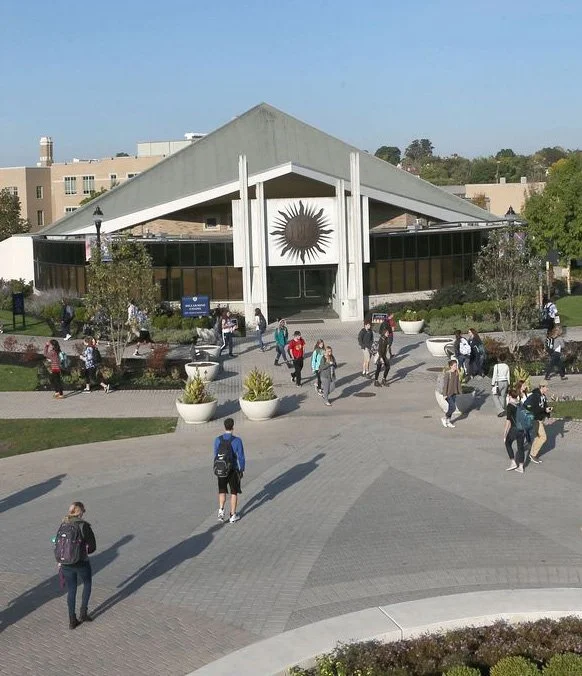
Kieth Daniel drives 30 minutes from his home in Kentucky to attend Mass at Bellarmine Chapel (pictured) at Xavier University in Cincinnati.
“That’s an opportunity for folks to get a taste of the Exercises through those two retreats,” says Fr. R.J. Fichtinger, SJ, the pastor at Saint Thomas More. “We also have a large number of parishioners who participate in the Spiritual Exercises in Daily Life, in the small group format as well as the one-on-one format that helps them grow in that journey.”
Saint Thomas More is one of five parishes in the country invited by Boston College to be part of its AMDG program, which focuses on the faith lives of young adults.
“It’s just a great opportunity to help people grow in that Ignatian milieu of finding God in all things, in serving the poor and the marginalized, in educating the kids and young people, and having a really solid commitment to the environment,” Fr. Fichtinger says.
Milwaukee demonstrates the diversity of parish commitments in the Midwest Province. Our Lady of Guadalupe and St. Patrick’s Parishes walk with Milwaukee’s Hispanic and Latino communities, while Church of the Gesu is on the campus of Marquette University. The parishes’ operations are different, but they share a common mission.
Gesu guides a group of parishioners each fall through the 19th Annotation retreat, an adaptation of the Spiritual Exercises that allows individuals to complete the traditional 30-day silent retreat over several months. Every Sunday, the parish’s morning breakfast feeds more than 50 people, and there are plans to expand it to Saturdays. Also, anyone who asks for help receives a home visit from Gesu’s St. Vincent de Paul Society.
“Last year we did more than 250, about five a week, which is a lot for a group of volunteers,” says Gesu pastor Fr. Michael Simone, SJ.
All of this—serving those in need, practicing faith, growing spiritually, receiving Ignatian messaging in homilies, and engaging in complex, relevant dialogue with priests and other parishioners—is what makes Jesuit parishes so attractive to so many people.
“Parishes are not outdated institutions,” Skarr says. “They are vital expressions and sources of mission to the Society.”
Father Fichtinger agrees: “As we like to say at Saint Thomas More, wherever you are in your journey, you belong here and you belong with Christ.”
IN THIS ISSUE
ON THE COVER
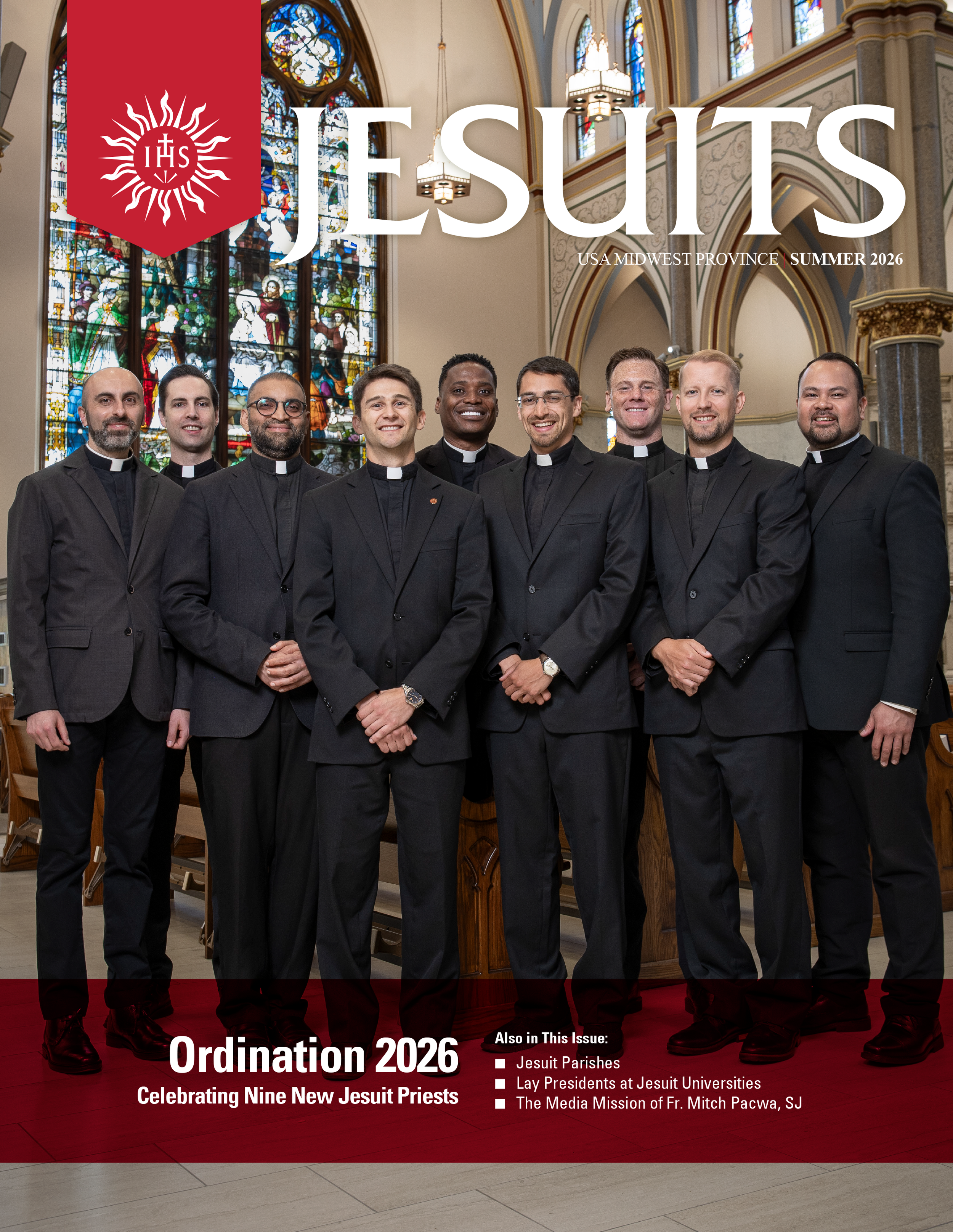
The 2026 ordinands at Church of the Gesu in Milwaukee.
Photo: Steve Donisch