
with the God of Surprises
By Fr. Endashaw Debrework, SJ
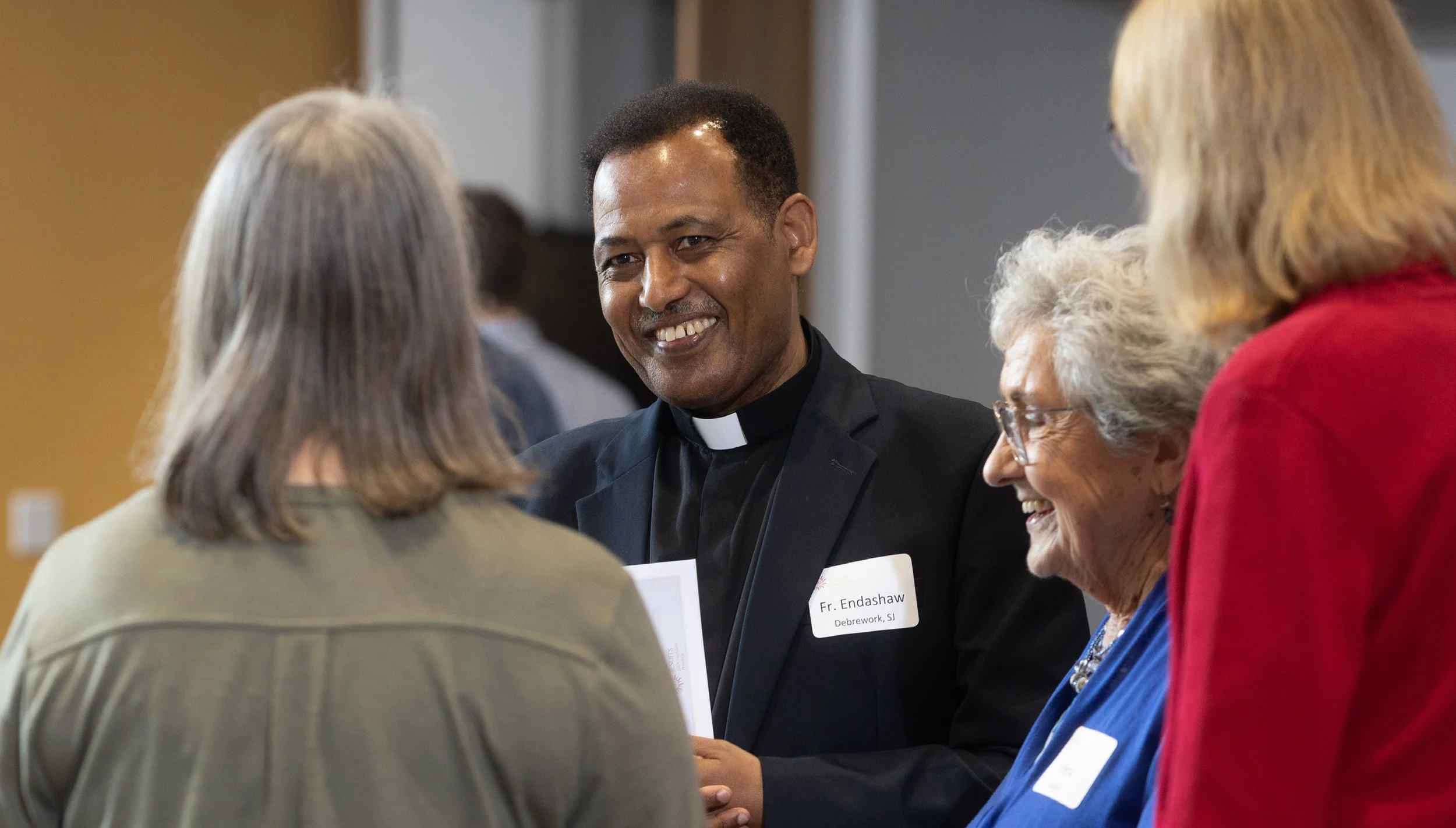
Fr. Endashaw Debrework, SJ, a native of Ethiopia, is based in the USA Midwest Province office in Chicago, where he raises funds for Hekima University, the first Jesuit university in Eastern Africa.

Introducing Hekima University, the First Jesuit University in Eastern Africa
Phase 1 (begun in 2024) Fencing, landscaping, roads, utilities, first stage of Jesuit residence construction (all completed); administration block with classrooms and offices, women’s dormitory, men’s dormitory, second stage of Jesuit residence, medical clinic and library.
Phase 2 Second academic building, two dormitories, two cafeterias and eight staff housing buildings.
Phase 3 Third academic building, administration building, Jesuit university parish, student center and commons.
Immediate Needs: Staff to fulfill requirements for Kenya’s Commission for University Education, library books and scholarships.
Proposed Schools: Data Science, Education Science, Engineering and Business.
For more information, or to donate, visit www.jesuitsmidwest.org/hekima. You can also contact Fr. Endashaw Debrework, SJ, directly at edebrework@jesuits.org, (773) 975- 5756 (ofc), or (773) 930-2396 (cell).
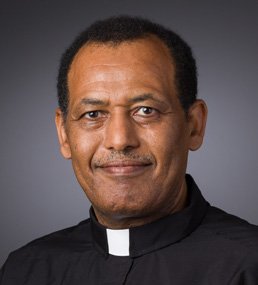
Fr. Endashaw Debrework, SJ, is an Eastern Africa Province Jesuit working as a fundraiser in the USA Midwest Province on behalf of Hekima University in Molo, Nairobi, Kenya.
Through periods of doubt, disbelief, rebellion and conversion, Fr. Endashaw Debrework, SJ, has experienced endless grace and the support of his family
I was born and raised in Ethiopia, in a devout family of the Ethiopian Orthodox Tewahedo Church. The Orthodox Church was not just an institution my family attended; it constituted the religious and cultural world through which I learned to understand God, community, morality and identity. Several members of my extended family have served the Orthodox Church as bishops and married priests. Consequently, when I first encountered Catholic priests and religious orders, the idea that someone might choose a life of celibacy for religious reasons was beyond my early understanding of religion.
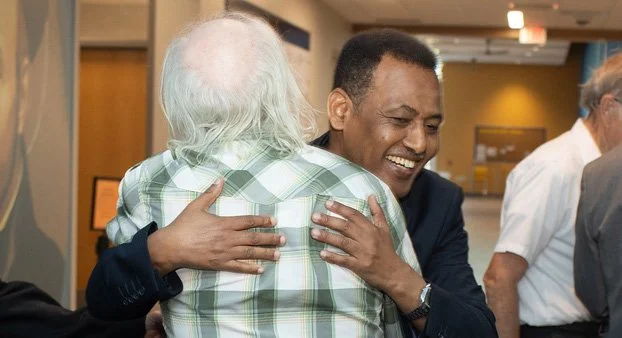
Fr. Endashaw Debrework, SJ, converted to Catholicism as a high school senior in his native Ethiopia. Although he experienced resistance from his family at first, their eventual support sustained him on his journey to become a Jesuit.
Paradoxically, through Catholic education, God broadened my imagination. My father placed great value on Catholic education. There, I encountered priests, nuns and brothers whose dedication to education, disciplined lives and selfless service challenged my preconceptions about Catholicism. Yet initially I had little interest in understanding their tradition. Proximity became encounter and encounter generated curiosity.
I spent my adolescence amid Ethiopia’s turbulent political and ideological environment. Socialist ideology held great sway over young people, and I was no exception. For a time, I believed religion was the “opium of the people” and thought political and social progress required liberation from religious belief. I harbored ambitions of becoming an anti-religious socialist activist. My family strongly resisted, but that ideological phase was more than just a detour from my vocation. It raised enduring questions about justice, inequality, human dignity, social transformation and the relationship between faith and public life. These questions, once framed through ideological categories, would eventually be reinterpreted through Christian faith and, later, the Jesuit commitment to a faith that does justice.
During my first year of high school, I became increasingly curious about Catholicism. I persistently questioned priests and nuns about Catholic teachings and the differences between Catholicism and Ethiopian Orthodoxy. Rather than dismissing my questions, they responded with patience and intellectual seriousness. What began as interrogation became discernment.
As a junior in high school, I told a priest and a nun I wanted to become Catholic. They did not celebrate prematurely or attempt to persuade me. Instead, they asked me to pray, think carefully about it, and speak honestly with my parents. That conversation proved extremely difficult. My mother initially opposed my decision and enlisted the help of relatives to persuade me otherwise. However, my father eventually supported my freedom of conscience and helped my mother and extended family accept my decision. With their blessing, I joined the Catholic Church during my senior year of high school.
Converting to Catholicism did not require me to reject my Orthodox heritage, but I am still the only Catholic in my immediate family. The Ethiopian Orthodox Tewahedo Church first gave me a language of faith, a reverence for mystery, a sacramental imagination and a consciousness of Christianity’s ancient roots while Catholicism opened another horizon so that inheritance could mature.
My conversion eventually led me to ask a deeper question: If God led me here, how should I respond? Seeing priests and religious people at work awakened in me a desire for priesthood and a life dedicated to service. After sustained discernment, I joined the Eastern Africa Province of the Society of Jesus in 1994. My understanding of vocation was transformed by Jesuit life, evolving from a single decision into an ongoing process of discernment. I continually sought God in changing circumstances, asking how my gifts might serve God’s people.
Today, my journey has brought me to Chicago and the Midwest Province of the Society of Jesus, although my ministry remains closely linked to Eastern Africa. I am currently involved in fundraising activities in support of the development of the first comprehensive Jesuit university in Eastern Africa, in Kenya. In this role, fundraising is an apostolic activity in itself, enabling us to build relationships, articulate our mission, cultivate generosity and invite others to participate in expanding educational opportunities for future generations.
In hindsight, my trajectory seems improbable: from Ethiopian Orthodoxy to adolescent socialist skepticism; from questioning Catholicism to embracing it; from finding the celibate priesthood incomprehensible to becoming a Jesuit priest; and from Eastern Africa to Chicago, all while continuing to serve Africa’s educational mission. Vocation is rarely linear. Mine has been characterized by interruption, questioning, conversion, accompaniment and mission. Throughout this journey, God has taught me that vocation is less about constructing one’s own future than about developing the freedom to recognize grace in the unexpected and respond generously. God asks once again, “Where can I send you now?”