An Only Child with Many Brothers
Br. Bobby Nichols, SJ, reflects on his calling to become a Jesuit brother
By Br. Bobby Nichols, SJ
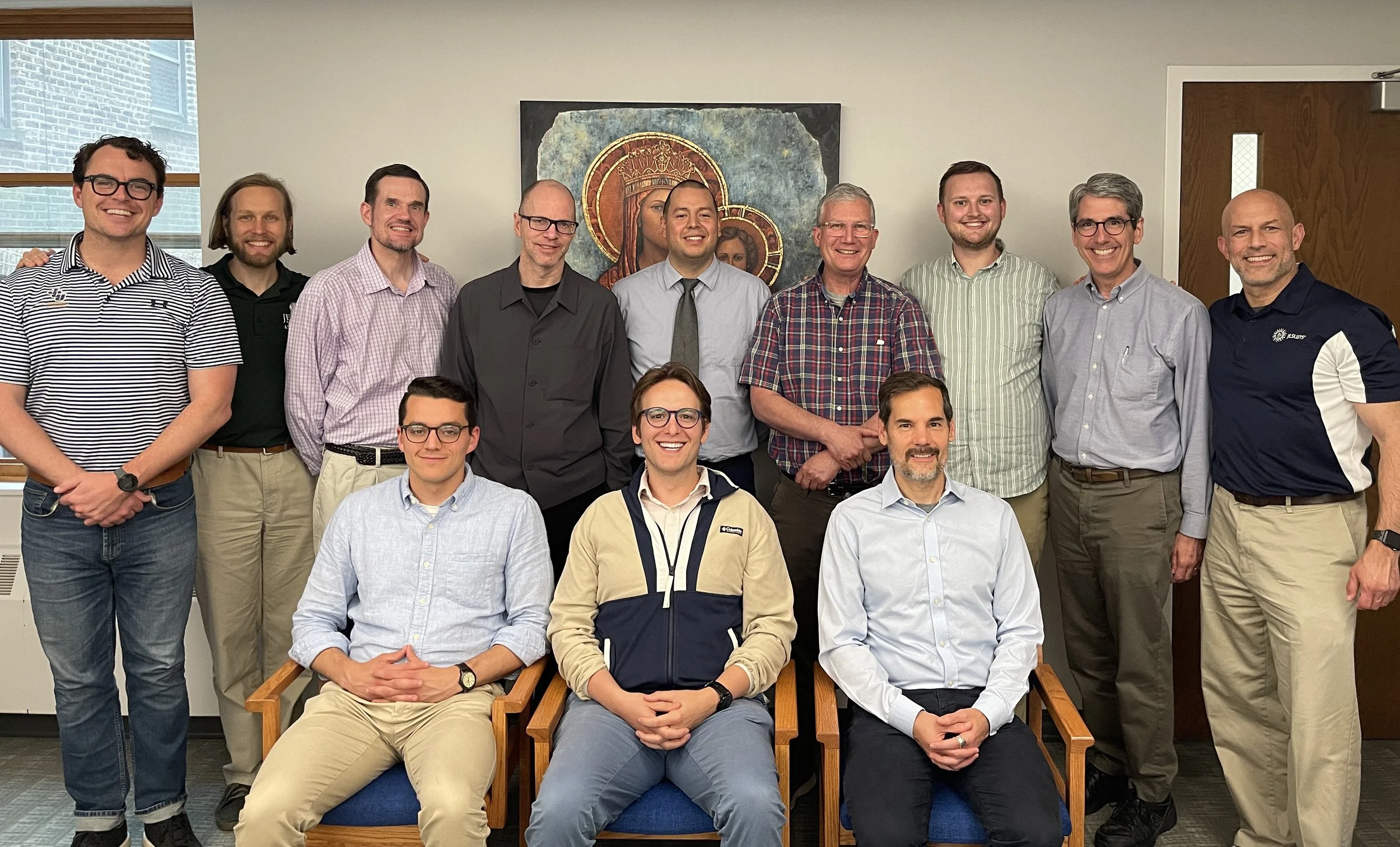
Br. Bobby Nichols, SJ, is pictured here (front row, center) at a private prayer service just before he and Jesuit Brs. Timothy Long (front row, left) and Mark Trombley (front row, right) took their vows. The Jesuit brothers who organized the prayer service (back row) also offered advice on being a brother in the Midwest Province. “I cried,” Br. Nichols says. “It was really tender.”
I am an only child, and I always wanted siblings. Growing up in Louisville, Ky., many of my friends incorporated me into their family; I could show up unannounced and find a seat waiting for me at their table. Being folded into other people’s families has been one of the great gifts of my life. And yet. Years later, working alongside the Xaverian brothers in Kenya, I watched men whose whole lives were organized around the identity of “Brother.” These were not merely a friendship that had grown into brotherhood, but a brotherhood that defined their life, shaped their day, and inspired their relationship with Christ and the world. How they engaged with the world resonated with something deep in my core.
In the Society of Jesus, not every Jesuit is a priest, and not every Jesuit is trying to become a priest. Just six years after the Society’s founding, St. Ignatius of Loyola petitioned Pope Paul III to allow the admission of “coadjutors.” These men were meant to be helpers and brothers to the priests and scholastics, to assist with building, maintaining and supporting the Society. For centuries, these brothers were the men who cooked, farmed, tailored and kept the door, freeing the priests for sacramental ministry. The patron saint of Jesuit brothers, St. Alphonsus Rodriguez, spent 46 years serving as the porter and doorman at a college in Majorca, Spain, where he greeted every visitor as though Christ himself had knocked.
Over the centuries, the role of the brother has widened. Brothers served as painters, architects and scientists. In 1995, during the 34th General Congregation, the Society articulated the role: “Brothers, in the same way as priests, are integrated into the Society by reason of the one common call of the Lord to follow him in living out the evangelical radicality of religious life…. In some ways the religious brother embodies religious life in its essence, and so is able to illustrate that life with particular clarity.”
This understanding of the Jesuit brother recognizes that brothers are “intimately involved in every apostolic task of the Society.” Today brothers serve as spiritual directors, catechists, teachers and administrators, accompanying both priests and lay collaborators in serving the needs of the Society, the Church and the world.
Men who enter the Society of Jesus spend two years of prayer, experiments and community life with the accompaniment of a spiritual director. During this time of discernment, the novice is able to respond to God’s call to serve as a scholastic, on the track to becoming ordained, or as a brother. Some men enter the novitiate undecided, asking the Spirit which path they are called to. Some enter certain and are surprised by how the Spirit directs them. Novitiate discernment is not meant to produce an answer quickly, but to ensure the answer is free.
I entered the novitiate feeling called to be a brother. The Xaverian Brothers I knew growing up had already put the possibility in front of me, and during my application process I met Jesuit brothers like Jim Boynton and Matt Wooters who made it feel less like an exception and more like an invitation. Still, I discerned it again in the novitiate in St. Paul, Minn., living with Br. Ralph Cordero, SJ, and talking it through with my novice director, Fr. James Grummer, SJ.
Discernment is like falling in love. In the moment, it looks naive, even reckless. Looking back, it looks inevitable. Of course you married that person; it just took a while to ask. When I look at the 10 years between college and the novitiate, at the friendships, classrooms and conversations, I cannot find a particular moment when I knew I was called to religious life. Yet, when I look back now at how I loved my friends, interacted with my students, and volunteered with and for the Church, it seems obvious and inevitable that I became a brother.
Brother Cordero, who is now in his 11th year as a member of the novitiate staff, describes his own calling as a way for him to follow Christ in the same brotherly companionship that Christ offered his disciples, “a form of discipleship rooted in presence, service and finding God in the ordinary.” Over the years, Br. Cordero has accompanied many men who were discerning the brother’s vocation, and he’s noticed that when “someone’s spirituality is rooted in service, particularly in the ordinary, it can be a strong beginning to their discernment as a brother.”
I’ve talked about this more than once with my classmates, Jesuit Brothers Mark Trombley and Tim Long, and we keep landing in the same place. Ordination carries a certain verticality. It sets a man in front of the people, at the altar, in the confessional, and that is a gift the Church could not survive without. But the brother’s vocation runs horizontally. Brothers sit in the pews with the people of God rather than stand before them. Brothers serve alongside people at the soup kitchen rather than arrive to bless it. Brothers serve as colleagues, teachers and companions on the road.
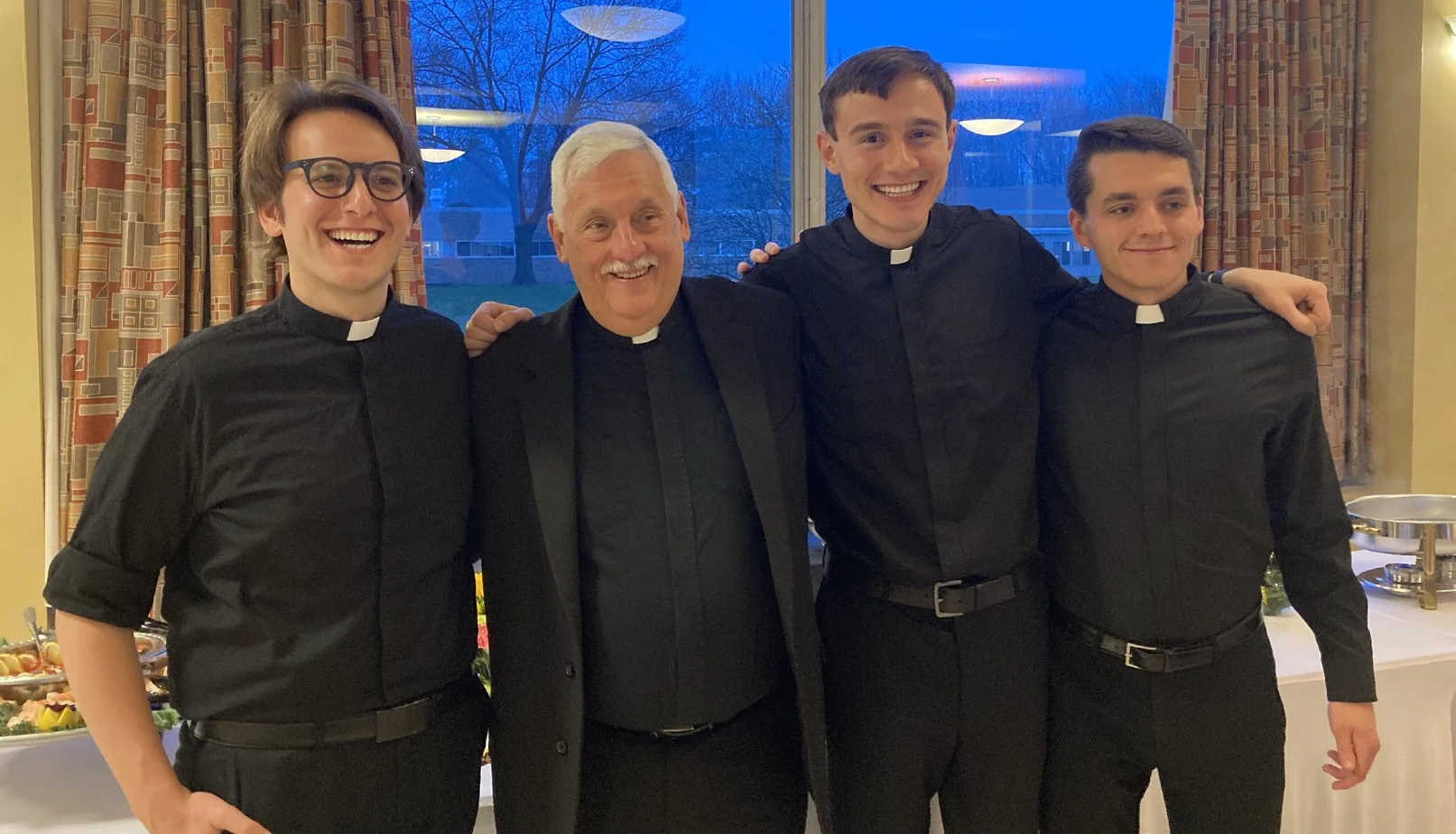
(From left) Br. Bobby Nichols, SJ, with Father General Arturo Sosa, SJ, and Jesuits Taylr Bahr and Br. Timothy Long at Colombiere Center in Michigan.
“The approachability brothers have with people, wherever they are in their faith and life, has always been consoling and inspiring,” Br. Trombley says.
None of this is a criticism of my brothers who are priests. It is a description of a different angle of approach. There are rooms brothers can walk into, and conversations brothers can have, where an ordained priest would change the temperature.
Think about how siblings actually work. When something goes wrong, you call your siblings first, before you call your parents, before you talk to your father. In that initial conversation, you can be raw, unfiltered and unafraid, as you seek counsel about the situation. Brothers “can meet people in the ways that ordained ministers cannot,” says Br. Sean Barry, SJ.
As a Jesuit brother, this is what I can offer to the Church: a bridge, a space for people to come and be present without fear or judgment, to be their brother and accompany them to the sacraments, sitting with them in the pews as fellow siblings and children of God.
When I decided to become a Jesuit, it was not initially easy for my mother to accept. She had imagined herself as a grandmother. Throughout my life, she saved little things she thought would make fun gifts, keepsakes and memories for my children. Recently, after my mom visited me in Chicago and spent a few days with me and some other Jesuits, she sent me a thank you note with this message: “I always wanted to give you the brothers and sisters you always wanted as a kid, and I see now that God finally gave you those siblings, and I now have more sons than I could have ever imagined.”