
What do I do?
Let me try to explain…
By Noah Banasiewicz, SJ
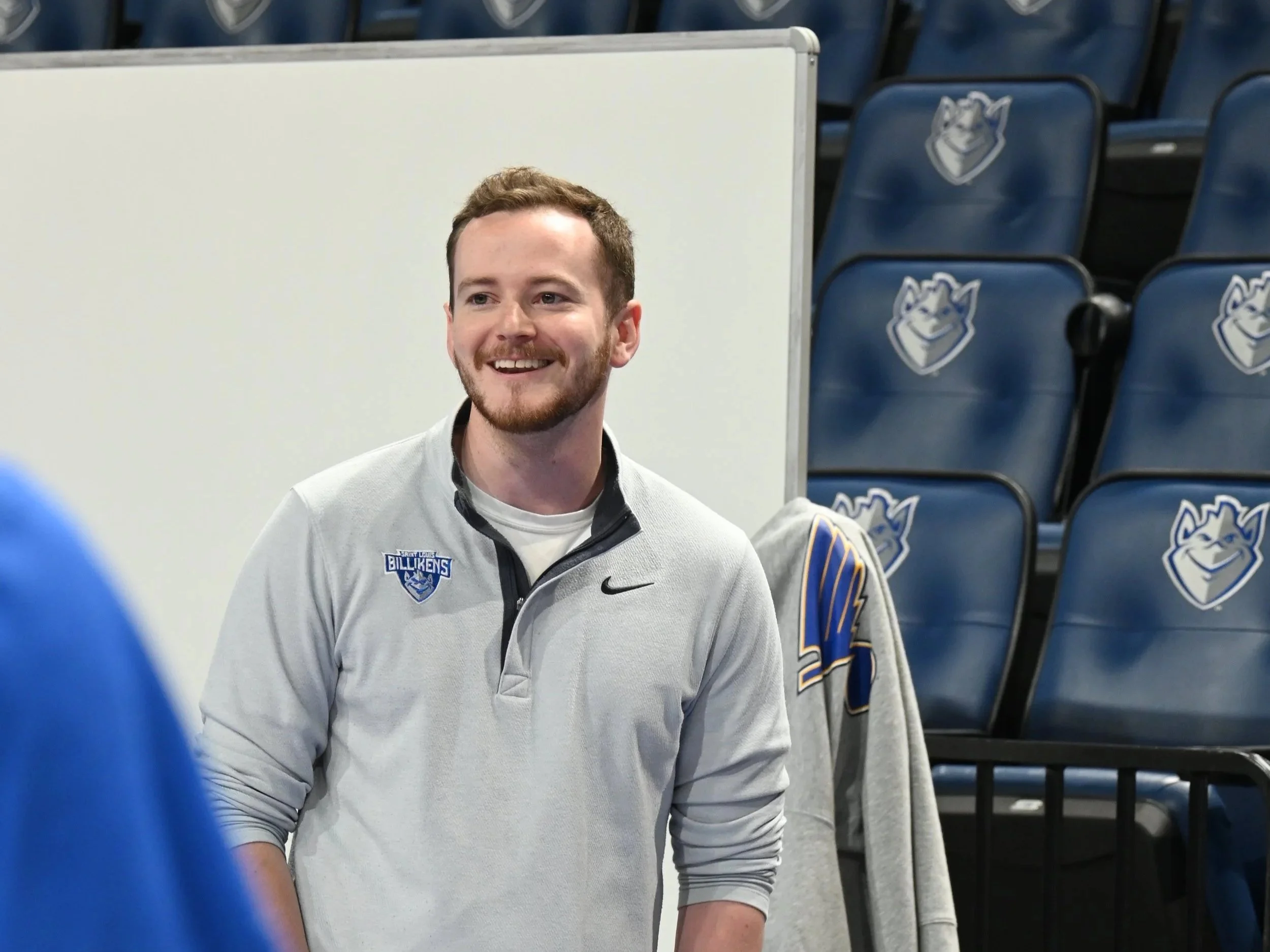
Noah Banasiewicz, SJ, in his days as chaplain to the Saint Louis University women’s volleyball team.
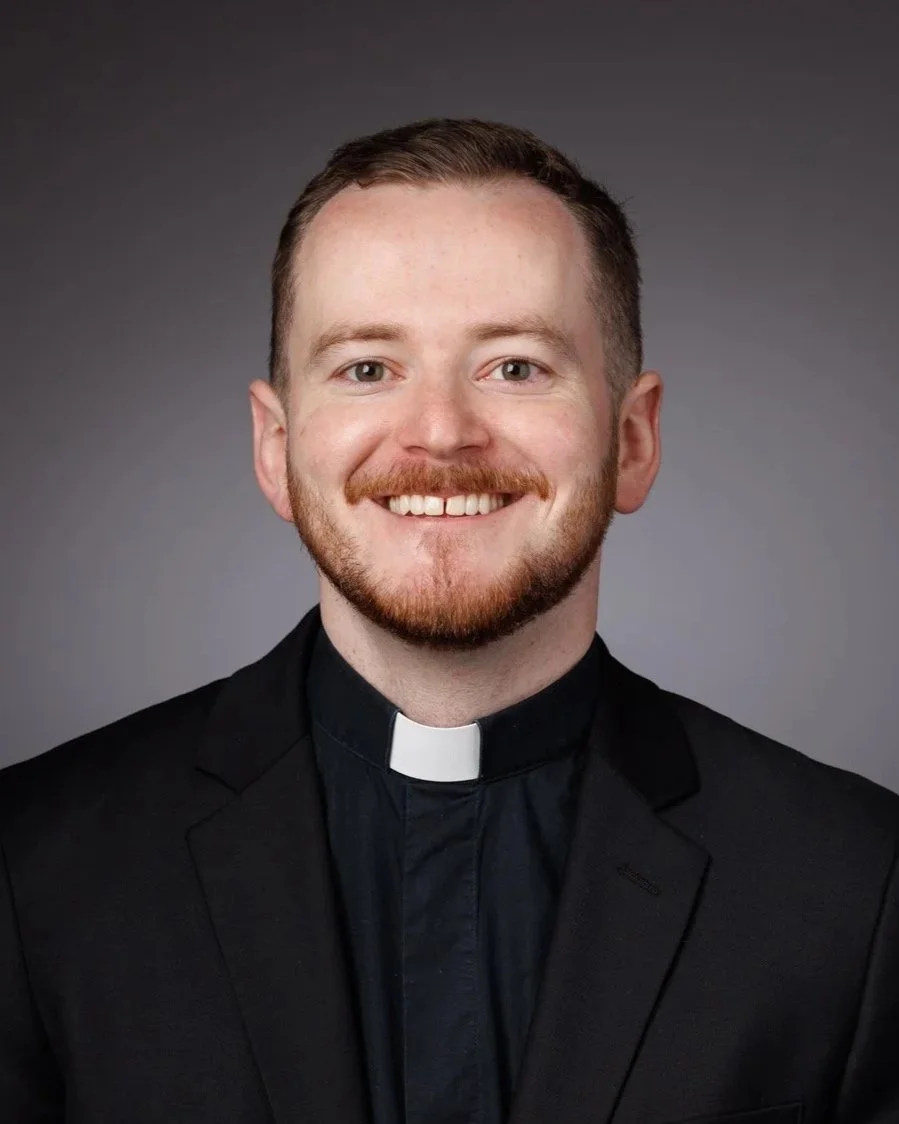
Noah Banasiewicz, SJ, is an instructor in the School of Communication at Loyola University Chicago. He entered the Society of Jesus in 2019.
One of the great hilarities that comes with being a Jesuit in formation is the constant struggle to explain who I am and what exactly it is that I do. Whether it be at the barber, a bar or simply meeting friends of friends, the question “What do you do?” doesn’t always yield a standard exchange of pleasantries. I have found that explaining my vocation and the vows I’ve pronounced frequently prompts general confusion and countless questions. Despite being funny or even slightly awkward in the beginning, these conversations often lead to opportunities for encounter and beautiful experiences of grace.
AS JESUITS, OUR LIFE AND MISSION CALL US TO BE A RELIGIOUS PRESENCE IN SPACES THAT MAY NOT SEEM EXPLICITLY RELIGIOUS TO OTHERS.
During my philosophy studies at Saint Louis University, I served as chaplain to the women’s volleyball team, and my experience of that question “What do you do?” became “What are you doing here? ” As is true with any other chaplain, my primary responsibility was to care for the spiritual lives of those I served, yet none of the players had ever had a chaplain before. Most were unfamiliar with the term “chaplain,” and for those who weren’t, it was in the context of a hospital, prison or the military.
Early in my first season, one player, introducing me to her parents after a match, tried to explain my role. “He’s kind of like a team mom…but a priest…almost?” she said.
Not quite, but I can work with that.
Much of society has become accustomed to a very compartmentalized view of religion and spirituality. It looks a certain way; it belongs in a particular place. As Jesuits, however, our life and mission call us to be a religious presence in spaces that may not seem explicitly religious to others. It is through this intentional form of accompaniment that we invite those we serve to truly “find God in all things.”
In some ways, that player’s explanation to her parents wasn’t too far off. Functionally, my role consisted mostly of conversations over coffee outside the gym, the occasional cookie drop-off before the team traveled for an away game, and even some pre-match handshakes that consisted of fist bumps and the sign of the cross. I prayed for the players by name every day, sat on the bench at games and even helped out at practices.
For the players who practiced a faith, we would talk about their prayer lives and their relationship with God. For others, struggles with mental health or navigating the excitement and exhaustion of college life were often the topics of conversation. As my time with the team prolonged and they came to know me and my role better, the dialogue deepened. The players I originally expected to be least likely to open up became the ones who most often asked to speak with me.
I found that for most of these individuals, their image of the Church was both distant and impersonal. As I listened to their struggles with divisions among their families or friends, with despair in the face of the vast strife throughout the world, or with the desire for a deeper meaning in life, there was a great hunger amidst it all. They were all, as Pope Paul VI describes, “manifesting a thirst for God.”
These encounters—in my personal life and within the moments of my ministry—are what get me out of bed in the morning and breathe life into my vocation. While some may feel disinterested in the Church, or disenchanted by it, spiritual hunger abounds in our world today. The seeming oddity of the Jesuit vocation in the eyes of others may initially be a space of confusion, but it is precisely in that space that we are called to walk with others. It is in that space that we are best-equipped to offer a vision of the world, and of the future, that is richer and more hope-filled.