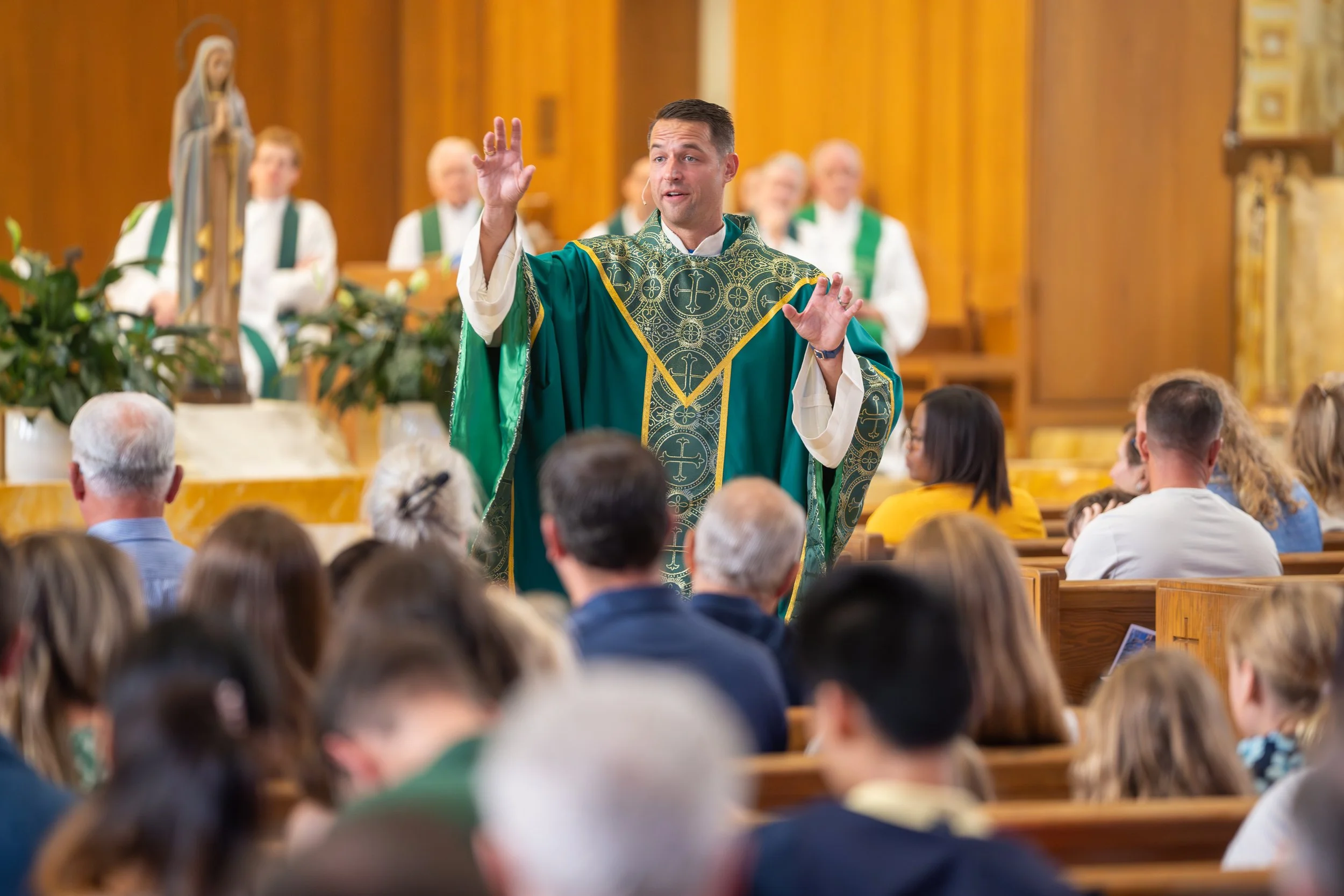
Fr. Lukas Laniauskas, SJ, of Church of the Gesu in Cleveland, reads and re-reads his homily and then shreds it on Saturday before he delivers it at Mass.
Patience Reveals the Message
How Three Jesuits Approach Their Homilies
By Garan Santicola
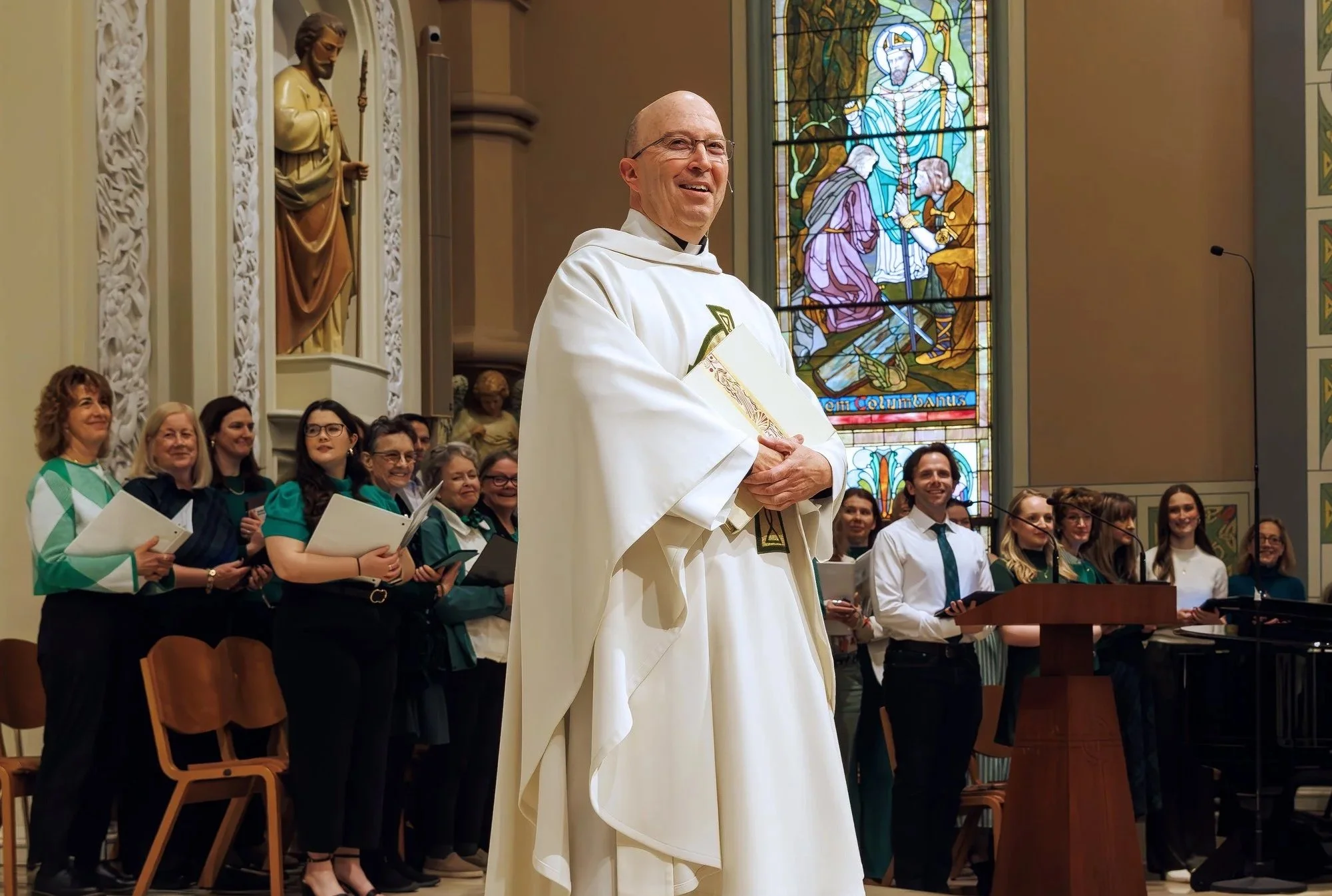
At Old St. Patrick’s Church in Chicago, Fr. Pat McGrath, SJ, looks at the following Sunday’s readings on Monday and contemplates them throughout the week.
On Mondays, after the dizziness of the weekend, Fr. Patrick McGrath, SJ, looks at the readings for the next Sunday.
“I just sit with them and pray quietly for a little while,” he says. “Over the course of the week, I try to pay attention to images or words or phrases that pop in the readings, discerning themes that seem to be woven throughout.”
As pastor of Old St. Patrick’s Church in Chicago, Fr. McGrath employs an intentional process to prepare his homilies—just like other Jesuits in the Midwest Province— mining Scripture for timeless truths while also speaking to the specific challenges of our time.
“It’s treacherous to try to make those very practical connections to what’s going on around us if it’s not tethered to what we know from 2,000 years ago,” Fr. McGrath says.
Parishioners are frustrated with what is happening in the world today, he says. They see a polarized society. They feel powerless. “I’m blessed that I serve in a parish that has a robust structure of programs. There are places to point people to and invitations to make, like to the immigration and refugee meeting, where they can find ways to be supportive.”
Father McGrath also searches for relevant connections in cultural sources like poetry and film. As Sunday approaches, he practices his homily from notes only—not a full, written piece—to hear what it sounds like. He then jots down four or five bullet points to guide the structure and theme when Sunday arrives.
JESUS IS NOT INTERESTED IN POLITICAL PARTIES. JESUS IS INTERESTED IN SANCTITY OF LIFE. JESUS IS INTERESTED IN SOCIAL JUSTICE. DO SOME OF THOSE THINGS HAVE POLITICAL IMPLICATIONS? ABSOLUTELY.
Regarding the contentious, ever-present issue of immigration, Fr. McGrath often references the leadership of the United States Conference of Catholic Bishops, his own archbishop, Cardinal Blase Cupich, and Pope Leo XIV, drawing strength from their Gospel-based statements on the dignity of the human person.
At the height of the immigration and deportation crisis in Chicago, Pope Leo XIV asked how we should treat others, “a reflection question,” as Fr. McGrath puts it.
The answer is simple to Fr. McGrath, and it comes out in his homilies. “You feed the hungry. You give drink to the thirsty. You visit the prisoner. You welcome the stranger.”
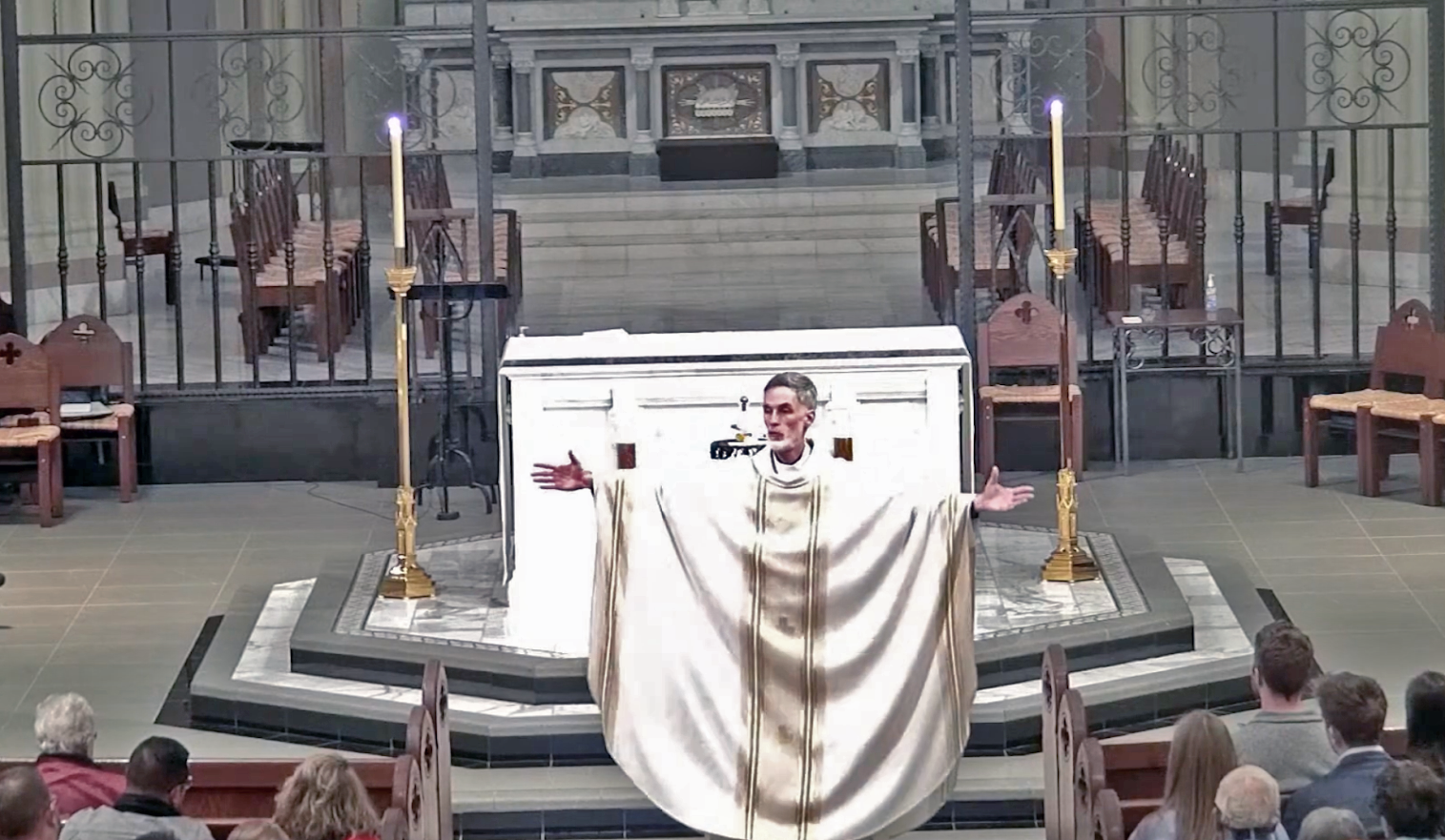
Fr. Matt Walsh, SJ, of St. John’s Parish at Creighton University in Omaha, delivers his homily for the first time during Mass at a care center that he visits every Friday.
For Fr. Lukas Laniauskas, SJ, pastor of Church of the Gesu in Cleveland, Monday is also the day when he opens himself to the readings. On Tuesday, he brings the Gospel and those readings into his prayers.
“I ask Jesus to show me any stories and remembrances to make a connection for people based on themes for the week,” Fr. Laniauskas says.
On Wednesday, he uses Ignatian contemplation to imagine being present in the scene of the Gospel with Christ and his disciples, and on Thursday, he creates an outline. Friday is the day he writes his homily.

Garan Santicola is a freelance writer who lives in the Catskill Mountains of upstate New York. His Beauty & Truth column on the arts has won multiple National Catholic Press awards. He writes regularly for The Christophers and is currently working on his first novel. He can be reached at garansanticola@gmail.com.
“I read it probably 567 times,” Fr. Laniauskas says. “And then, Saturday, by 4:30, here we go, I step out, and I shred the sheet of paper. This is to allow room for the Holy Spirit, and there have been times I’m preparing and truly feel a call to move more in this direction or that direction as it’s happening.”
Noting the political diversity of his parish, and our particularly divided nation, Fr. Laniauskas is careful to choose words that underline the Gospel message.
“Jesus is not interested in political parties,” he says. “Jesus is interested in sanctity of life. Jesus is interested in social justice. Do some of those things have political implications? Absolutely. But that’s where we have the beauty and breadth of our Catholic tradition, and we need to be balanced.”
Father Matt Walsh, SJ, pastor of St. John’s Parish at Creighton University in Omaha, preaches examination of conscience to overcome division.
“Society is becoming unrepentant, it seems, in its division,” Fr. Walsh says. “So, I ask myself, how do I need to repent? How do I need to be converted so that I can really be an example to others of all that needs to unfold in my life, in our society, in our culture?”
Father Walsh also looks to the Church calendar for homily inspiration. “There might be a day or a weekend where the Church really wants to communicate the theme of reconciliation—reconciliation with God, reconciliation with and among humanity, reconciliation with creation.”
On Fridays, when Fr. Walsh visits a care facility and celebrates Mass, he presents for the first time the ideas he’s been formulating throughout the week. Back at St. John’s, many of his parishioners are familiar with the Spiritual Exercises, so he expects his homily ideas will carry over into ongoing conversations beyond Mass.
“We can always see the dynamics of the Spiritual Exercises within our own lives, and also within our world,” Fr. Walsh says. “That means we look out and see the beauty of creation. We also see the reality of sin. And those are themes right from the first week of the Spiritual Exercises. We see the activity of God. We see the suffering and death. We experience it ourselves in various ways, and we also experience resurrection.”