


Dan Bellino, president of the Major League Baseball Umpires Association, graduated from Loyola Academy in Wilmette, Ill.
Professional umpires and referees draw on their Jesuit educations to succeed
By Patricia McGeever
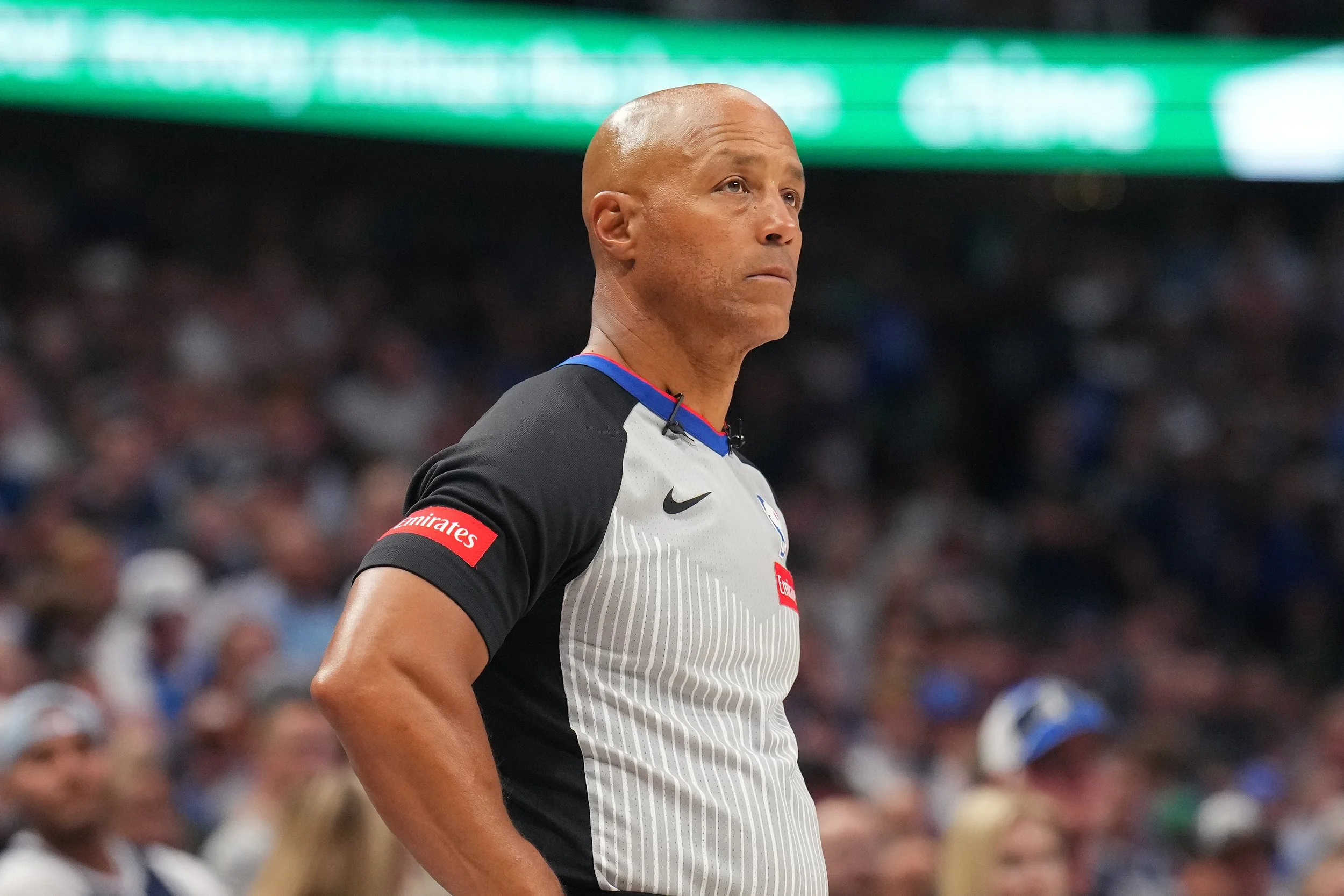
Marc Davis, a graduate of Chicago’s Saint Ignatius College Prep, is president of the National Basketball Referees Association.
From the time he was 10 years old, Ben May knew what he wanted to do when he grew up.
“I’ve loved baseball all my life,” he says. “I would watch the games, and I wouldn’t really watch the players. I’d watch the umpires. When we’d have pickup games in the neighborhood, if we had uneven teams I would just volunteer to umpire.”
The 2005 Marquette University (MU) graduate started umpiring city league baseball games when he was 15 and playing on his high school team. “By the age of 16, I was doing summer beer league baseball,” he says. “Some pretty surly older guys.”
In 2007, he was hired as a minor league umpire, and in 2022, he made it to the Big Leagues—literally—calling balls and strikes full-time for Major League Baseball (MLB). May and several other Jesuit-educated umpires and referees have turned their passion for officiating into a professional career.
“I would not have gotten my job in the Big Leagues without getting a degree from Marquette,” says May, who studied sociology. “It was pivotal and very important.”
A Jesuit education was also important for Marc Davis, a National Basketball Association (NBA) referee and president of the National Basketball Referees Association. He graduated from Chicago’s Saint Ignatius College Prep (SICP) in 1986. This past September he returned to speak about the benefits of his education as part of a panel focused on student athletes, NIL (name, image and likeness) deals and the NBA.
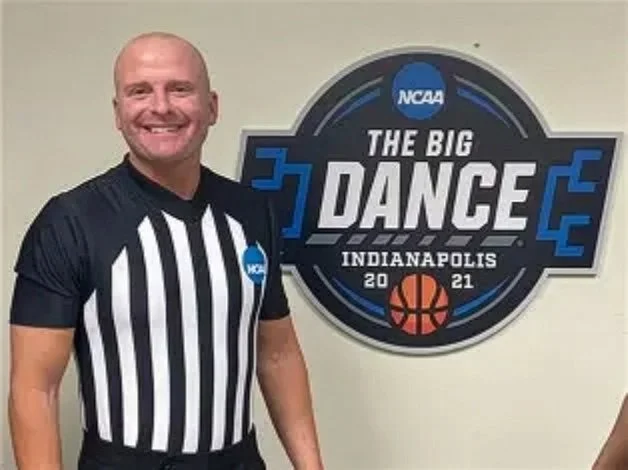
John Floyd credits his alma mater, St. John’s Jesuit High School and Academy in Toledo, Ohio, for molding him into the official he is today.
“My experiences at SICP were profound and most impactful, especially because I met my wife Julie here,” he said on the panel. “Now my three children are here. They had a choice of where to go to high school, but only a 49% vote in the matter.”
Davis, who has officiated 23 NBA Finals games and two NBA All-Star games, said SICP impressed upon him a commitment to serve others, as Jesuit schools do. But SICP also taught him to advocate for himself and others.
“The resilience is instilled,” he said. “And there’s a beauty of this school that is a direct reflection of the connections and the kinship. This is why alumni shout “Ignatius” to me at the arenas on the road.”
Another referee running the hardwood is former St. John’s Jesuit High School and Academy (Toledo, Ohio) basketball standout John Floyd, a 6’2” guard, who as a senior in 2002 was named first team All-State and Toledo City League Player of the Year.

Marquette University alumnus Ben May knew he wanted to be an umpire from the age of 10.
He played at Bowling Green State University and considered coaching after graduating. But a referee he’d gotten to know opened his eyes to officiating. Floyd worked his way up from grade school games to high school and college, and finally got the call to work the Big Dance, the NCAA Division I Men’s Basketball Tournament, in 2019.
“I remember taking a moment and literally just smiling, as this was something that seemed so far off when I first began working youth games,” he says.
He’s worked a total of five NCAA Tournaments, and he cites two things he learned as SJJ for molding him into the official he is today.
“First, Men for Others,” he says. “I’m there to serve the game and be the calming voice in what can be chaotic situations at times. The games are never about me. Second, Magis. As I’ve grown in my officiating career, I try to be a guy who others can look to for leadership and guidance in pursuit of achieving their own goals.”
Dan Bellino didn’t play sports in college, but he did play basketball, baseball and football at Loyola Academy (LA) in Wilmette, Ill. After graduating in 1996, he went on to Northern Illinois University, where he served as manager of the basketball team.
“My interaction with officials was behind the scenes, which made me realize that this is a unique mindset and something I was drawn to,” he says. “I enjoyed the impartiality, and trying to go out and officiate the perfect game, and also the rules. I was one of those managers that was studying the rules and trying to understand all the different calls.”
Bellino’s goal was to become an attorney and officiate NCAA Division I basketball games. Instead, after law school, he enrolled in umpire school. Since 2006 he’s been a practicing attorney, and since 2010 he’s also been a Major League umpire. Highlights of his career include the 2016 All-Star game and the 2021 World Series.

Patricia McGeever, is an award-winning freelance writer and television news producer based in Cincinnati. A proud Xavier Musketeer, she is a retired Irish dancer and instructor.
Bellino credits LA for teaching him lessons that couldn’t have come from a textbook— lessons about making the right decision.
“It’s about understanding that you should be driven by your moral compass,” he says. “Loyola is just an outstanding school. I had the benefit of some really outstanding coaches, just very good human beings. I still stay in touch with them. Some really, really high-character, high-caliber individuals helped me along the way in my development as a young man and going into my professional career.”
Today, he is president of the Major League Baseball Umpires Association and continues to practice law year-round. Games are at night, and his law practice schedule is flexible. Still, he has to be careful with his time and energy. “I’m very selective of what cases I take so I won’t overextend myself,” he says.
Fellow MLB umpire May, one of many people in his family to graduate from MU, recalls volunteering as an assistant coach of a YMCA football team for inner city kids in Milwaukee. “I felt like that was a part of my experience at Marquette,” he says. “Serving a community is part of the Jesuit way.”
No matter your background, or your future, a Jesuit education instills those values.
“The most significant is the spiritual and intellectual foundation,” Davis said at SICP. “Even for non-Catholics, I believe they understand that you may not be Catholic, but you will be Jesuit.”