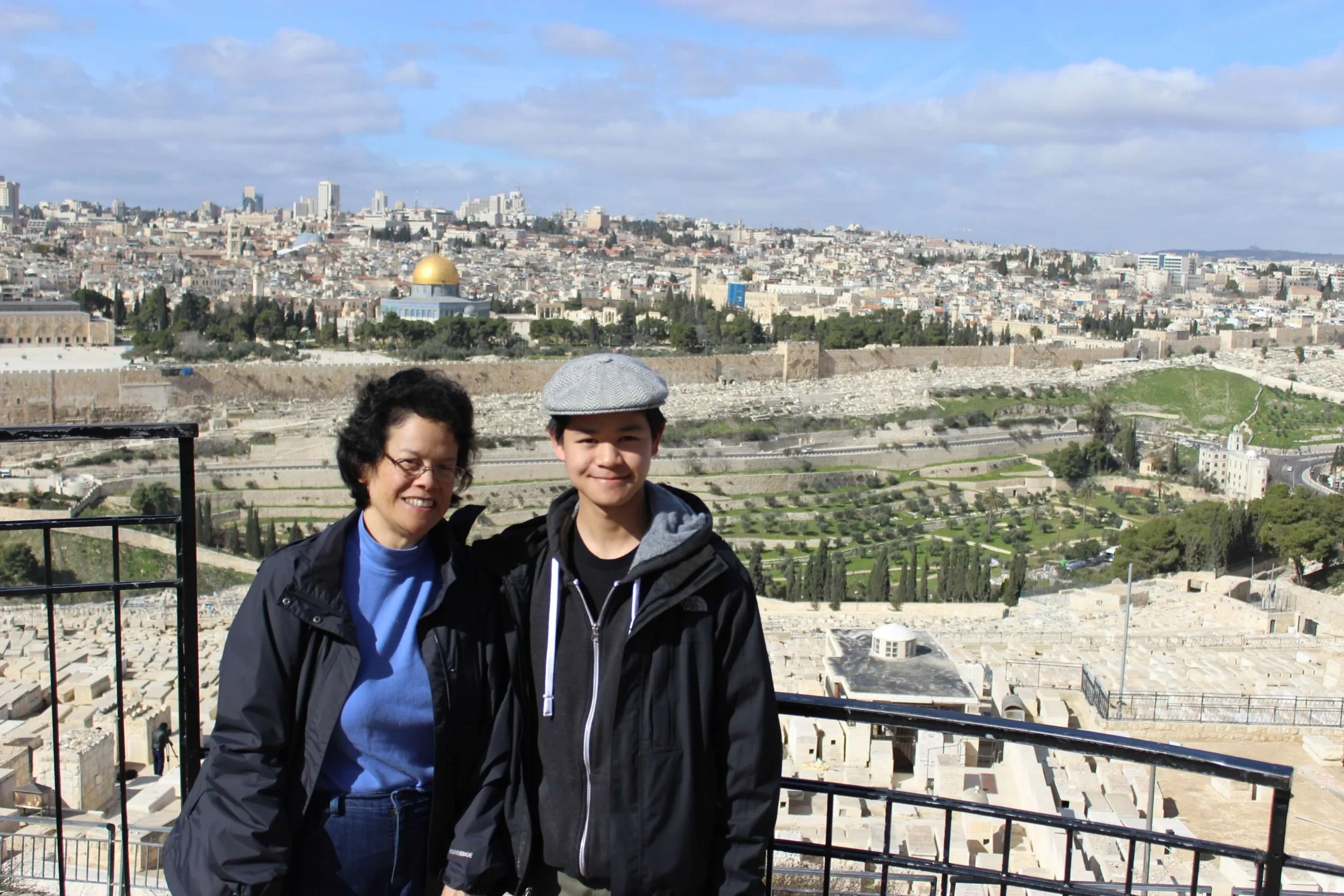
Jonathan Jue-Wong, SJ, while in college, visiting Jerusalem with his mother, Jennifer, an ordained minister in the United Methodist Church.
By Patricia McGeever
When men convert to Catholicism, and later become Jesuits, the world sees what was in them all along
Not all Jesuits started life as Catholics.
Stretching back to and including St. Ignatius of Loyola, the founder of the Society of Jesus, men have found their way to Catholicism and later became Jesuits.
The 19th-century poet Fr. Gerard Manley Hopkins, SJ, practiced the Anglican faith before his conversion. Cardinal Avery Dulles, SJ, had been a devout Presbyterian. More recently, Cyrus Habib, SJ, converted to Catholicism and served as lieutenant governor of the state of Washington before entering the Society of Jesus. Famously, St. Ignatius himself experienced a religious conversion while recovering from a critical war wound in Spain. Today, several Midwest Jesuits are men who grew up in different faith traditions, or with no religion at all, before converting to Catholicism.
Father Bryan Paulsen, SJ, who teaches chemical and biomolecular engineering at the University of Notre Dame, was received into the Catholic Church in 2008 and ordained in 2024. His faith life began in a small, tight-knit evangelical fundamentalist church in suburban Chicago. College exposed him to other Protestant traditions—and to Catholicism— and in graduate school, he read up on the Jesuits. He was impressed by their mission and sought out a Jesuit parish for Mass. A priest there encouraged him to meet with a faith formation director to learn more, and by the end of that conversation, he was on the parish’s community organizing committee. It made for a strange disconnect.
I REALLY BELIEVE ON A SPIRITUAL LEVEL THE BLESSED MOTHER DREW ME TO HER SON.
“I was kind of living out my social implications of my faith in a Catholic parish,” he recalls. “I was worshipping in a Baptist church. At some point I needed to decide how to merge these two into one.”
The way to do it, he decided, was to enter the Rite of Christian Initiation of Adults (RCIA) program. Midway through, he told his family about his intention to convert. It took a while, but eventually they supported his decision.
“Really, everything I was, exists in the Catholic Church—just more of it,” Fr. Paulsen says. “I’m a Baptist who now receives the sacraments.”
Brother Timothy Long, SJ, pronounced first vows in 2025 and is pursuing a master’s degree in ethics at Fordham University in New York. He, too, was raised in an evangelical fundamentalist church—his father was a pastor—but as he got closer to high school graduation, he looked for his own home in Christianity.
Catholic friends gave him The Jesuit Guide to (Almost) Everything: A Spirituality for Real Life by Fr. James Martin, SJ, and that book made a deep impression. In college, he began attending Mass, and at age 19 he went through RCIA.
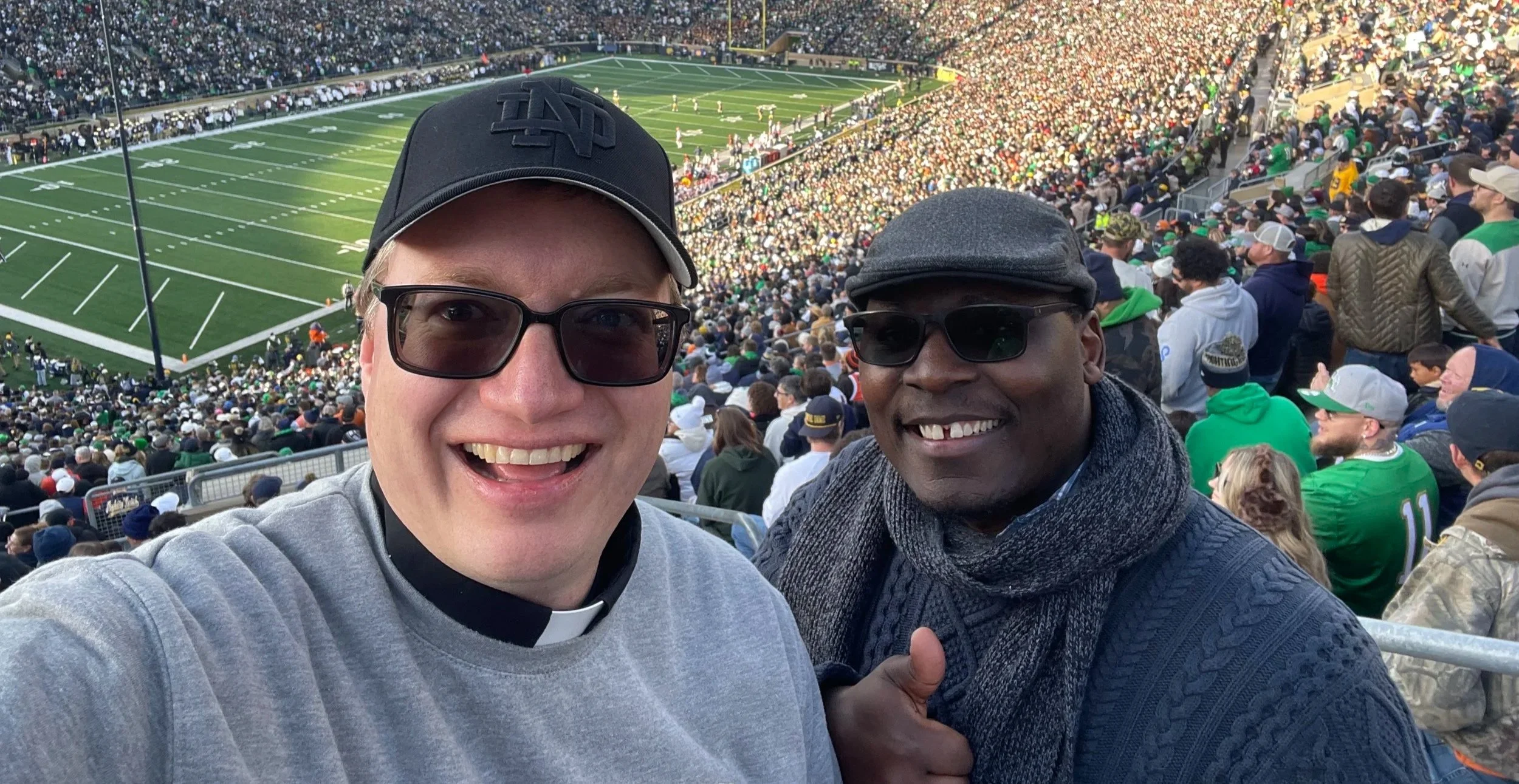
Jesuit Frs. Bryan Paulsen (left) and Garbiel Tolande take in a football game at the University of Notre Dame, where Fr. Paulsen teaches chemical and biomolecular engineering.
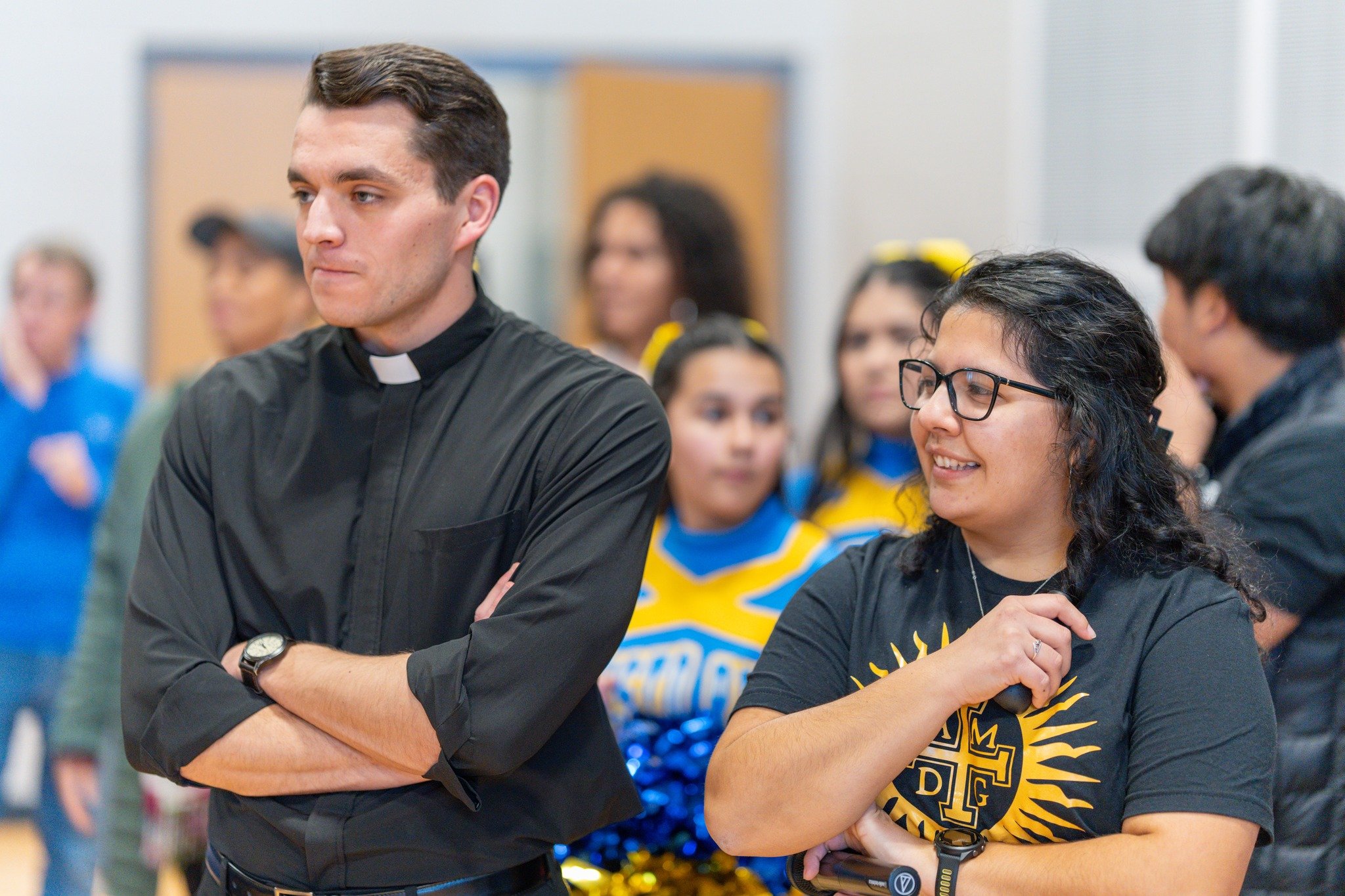
Brother Timothy Long, SJ, was raised in an evangelical church—his father was a pastor— but as he got older he looked for his own home in Christianity.
“If I was going to remain a Christian, I was going to be Catholic,” Br. Long says.
A difficult conversation with his parents followed. It took them about a year to come around, but in the end, their relationship was strengthened. After converting, he felt a call to religious life. A silent retreat confirmed the feeling, but still there were ups and downs with his seven siblings.
“In the novitiate, we do this pilgrimage for a month, where we don’t have a phone or money, and we’re depending on other people’s hospitality,” he says. “That made my sister think I was in a cult. But it’s a process, and on the whole my siblings are very supportive.”
Growing up in Hawaii, Fr. Kyle Shinseki, SJ, didn’t practice any particular religion. His parents encouraged him to explore faith, and while he was in college, he found an Our Lady of Guadalupe candle that reminded him of a family back home. He bought more of the candles and lit them without understanding their religious significance.
“I really believe on a spiritual level the Blessed Mother drew me to her son,” Fr. Shinseki says.
Later, working in Washington, D.C., Fr. Shinseki was invited to a gathering led by a Spanish Jesuit. “I began participating with this group on a weekly basis and got to know the Spiritual Exercises, Ignatian spirituality. It spoke to me a lot.”
Father Shinseki tried to close the door to a vocation, but a retreat blew it open, and he was ordained in 2018.
Jonathan Jue-Wong, SJ, is a scholastic in first studies at Loyola University Chicago. He was raised in the United Methodist Church, where his grandfather and mother were both ordained ministers.
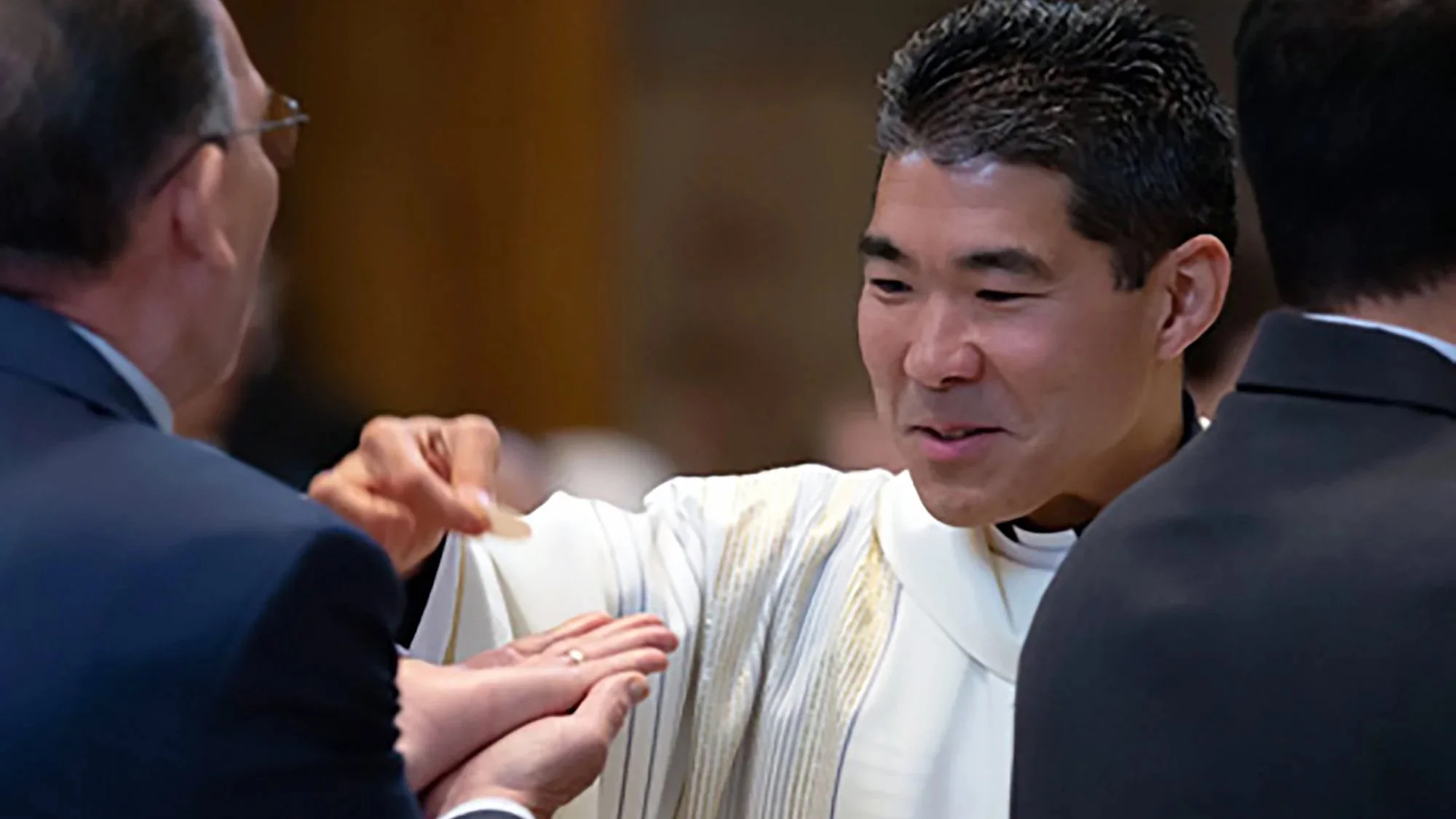
Growing up in Hawaii, Fr. Kyle Shinseki, SJ, practiced no particular religion. His parents encouraged him to explore faith in college.
When college came around, he “opted out” of religion and considered himself agnostic for two or three years. He meditated and practiced yoga but still felt unfulfilled.
“It’s a mysterious thing to describe, but when you’re in this place of spiritual famine or wilderness, you’ll try out different things,” he says. “For me, it was at this point of spiritual hunger and desperation that I found myself in a Catholic church that was nearby.”
IT’S A MYSTERIOUS THING TO DESCRIBE, BUT WHEN YOU’RE IN THIS PLACE OF SPIRITUAL FAMINE OR WILDERNESS, YOU’LL TRY OUT DIFFERENT THINGS. FOR ME, IT WAS AT THIS POINT OF SPIRITUAL HUNGER AND DESPERATION THAT I FOUND MYSELF IN A CATHOLIC CHURCH THAT WAS NEARBY.
Catholics weren’t completely foreign to him, as he has Catholic relatives on his father’s side. He had also visited cathedrals and basilicas during family vacations abroad, and those experiences left lasting impressions of the Church’s worship, tradition and rich history. Without entirely understanding what was happening at Mass, he started attending regularly.
“I was getting a taste of truth, beauty and goodness, and with that taste, I wanted more,” Jue-Wong says.
He joined RCIA and began to discern a vocation after being received into the Church. Today he sees parallels between the Jesuit traditions of mercy and justice and his Methodist upbringing. Yet the differences remain with the devout Methodist members of his family.
“We have some really interesting conversations, especially around the Eucharist and around Communion,” Jue-Wong says. “So, things are not totally smooth sailing, but there’s definitely an open line of dialogue.”
Surely these men experienced great change after their conversions, but as Fr. Paulsen sees it, becoming Catholic, and later a Jesuit, simply brought out what was in him from the start.
“It’s more like going deeper and being more of an expansion of what you already are,” he says.