
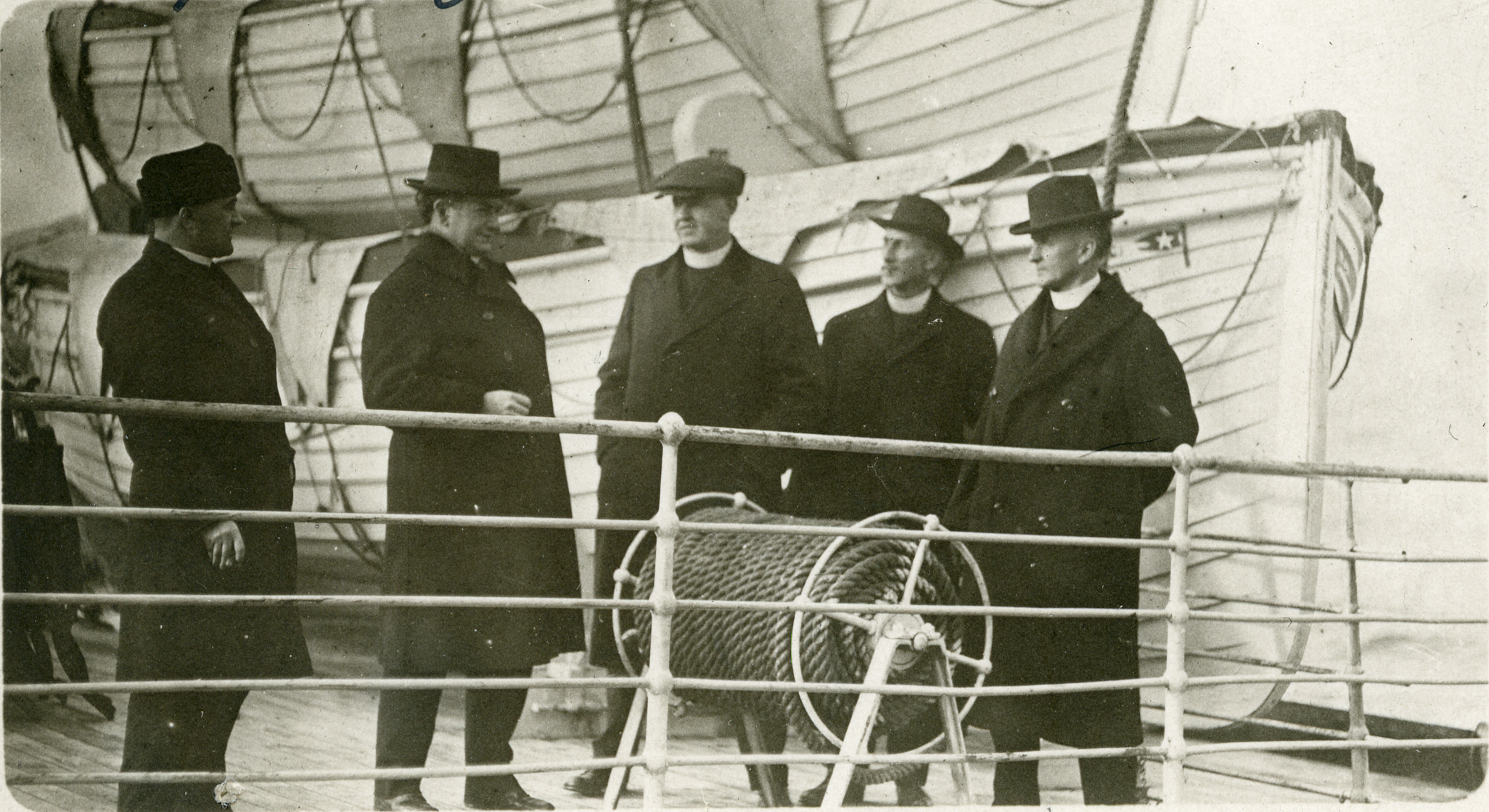

Jesuit Frs. (from left) Thomas Kelly, Edward Anderson, Patrick Troy, Henry Milet and William Eline aboard the S.S. Celtic from New York to Liverpool on their way to Patna in January 1921.
After more than 100 years, the Patna Province in India continues to do what Jesuits established it to do in the 1920s. Very Rev. Karl Kiser, SJ, recounts his visit to the region and encourages fellow Jesuits to reignite their imaginations
As Jesuits, where are we going, what are we called to do, and who are we called to be?
Those are the questions on my mind all the time, especially when I think of Patna, India, one of the greatest gifts of the Midwest Province.
The first experience I had of Patna was as a novice. The guys ahead of us, and the provincials, talked about Patna often because they knew the men there. This instilled in me that Patna was important to us.
But over the years, it had sort of faded away. Several years ago, Fr. Thomas Chillikulam, SJ, from the Patna Province, renewed the relationship, reminded us of the warm, effective, fraternal relationship we had with Patna. That’s why I decided to make a visit there.
Before I went, I ran into the Patna formation director at a conference in Rome.
I said, “I’m from the Midwest Province, Chicago-Detroit.”
He said, “Oh, our founder, our founder.”
I was taken aback because I hadn’t thought of it that way. Other religious groups were there before us, but the Chicago-Detroit Province founded the missions in Patna. Technically, the first Jesuits to arrive were from the Missouri Province, but they soon transferred Patna to us. Our men from the shores of the Great Lakes—Chicago, Cincinnati, Toledo, Detroit, Cincinnati—went there to build a province.
They adopted the things that were already established—a high school in the huge city of Patna, for example—but soon enough, they went into the countryside and opened parishes and schools everywhere. They learned Hindi and Bhojpuri. To this day, there are plaques and statues honoring them, the Chicago-Detroit Jesuits who established those parishes.
To go to Patna was really powerful for me. One of the Jesuits there said to me, “After Vatican II, everybody talked about the preferential option for the poor. We never had those conversations. We didn’t have to have them because when your guys came here, the first thing they did was go to the rural areas, where people were unserved and had no education.”
We just have it in our DNA as a province that the poor are the heart of what we do. You might wonder how those Jesuits in Patna did this. Well, if you were a Chicago or Detroit school or parish, there were mission collections. People put in a quarter a month at Gesu Detroit, and at Saint Ignatius High School in Cleveland, and all the other schools that had monthly mission collections. Those quarters and dollars built institutions all over the Patna Province. What a beautiful connection.
One of the Jesuits in Patna, the treasurer, told me he had visited a lot of the people who contributed. They were people who lived simply, he said. They didn’t have a lot of money. They gave five and ten dollars, but it really made a big difference. None of our provinces in India are wealthy, but Patna isn’t poor. Why? Because of nickels and dimes from kids in our grade schools, in our high schools, in our parishes—from Cleveland, Cincinnati, Chicago, Detroit, Toledo.
I asked myself when I was over there if I could go away today and leave everything behind knowing I’d have to learn two languages I’ve never heard before, and go to rural areas where I don’t know a soul and build a religious community, and maybe never come home. Could I do this today?
THOSE MIDWEST PROVINCE JESUITS IN PATNA WERE IN DIALOGUE WITH THE WORLD.
THEY WEREN’T AFRAID TO MEET ANOTHER CULTURE BECAUSE THEY KNEW IT WAS GOD’S CREATION, GOD’S CULTURE.
They did. They are our brothers who came right from these shores—where we come from, too. I left Patna so inspired by what our brothers did there that my vocation was reignited. I saw the connections between people here and people there that I’d never contemplated. In that vision, I told myself there’s something we have to grab onto.
It’s a great vision for all of us to consider. What does it look like today? How do we recover that kind of zeal, that kind of connection for the Gospel today?
I was at home when we heard “Habemus Papam, we have a new pope,” Pope Leo XIV.
When he talked to the cardinals in his first address, he mentioned the need to return to the primacy of Christ in our proclamation, to be missionary disciples, to grow in synodality and collegiality, to pay attention to sensus fidei— our sense of faith—to care for the least and the rejected, and to be in dialogue with the world.
This is what our Jesuit brothers did in Patna.
The primacy of preaching Christ drove them to be able to say, “I’ll leave everything. To preach Christ, I will leave everything and go.”
I imagine those early years, when some of them lived in mud huts. I imagine how they would speak at night about what they would need to do next. We don’t live in mud huts, but do we talk to each other in that way? Do we think about what we can do next or how we can do it better? Do we pay attention to the sensus fidei and ask where the people of God need us? Do we ask how we can care for the least and the rejected, and how we need to preach to them?
Father, your Jesuits taught us to go right to the poor. Those Midwest Province Jesuits in Patna were in dialogue with the world. They weren’t afraid to meet another culture because they knew it was God’s creation, God’s culture. As I think about where we need to go, I think I can see it in what I experienced in Patna.
We’re called today to have that zeal to proclaim the Gospel—to be missionaries, disciples—to go out, to not be comfortable. It’s really easy to be comfortable. I love being comfortable. But we don’t need to be comfortable.
The world’s a hard place. We believe in Jesus. We have hope. We are not afraid to be in dialogue with the world. To do this, we need to develop an imagination again, to be missionaries, disciples—to reawaken our imag-ination on where the Church needs us today and where we are called to serve. We need to lean into our vocation to be companions of Jesus.
Everyone lives and works in a silo, and silos are not bad. But it’s really good when someone gets out of their silo and says, “Oh, there’s another way to do this.”
In the merger of the provinces of the U.S. and Canada several years ago, our province made a strong effort to keep a close fraternal relationship with the provinces that we once called “the missions.” So, it is easy for us to go for a visit and see things that enrich us; we can see the Church a little more broadly. We can see the Church in all its beauty and diversity, in new ways. This is a huge blessing for our province, to have these wonderful relationships.
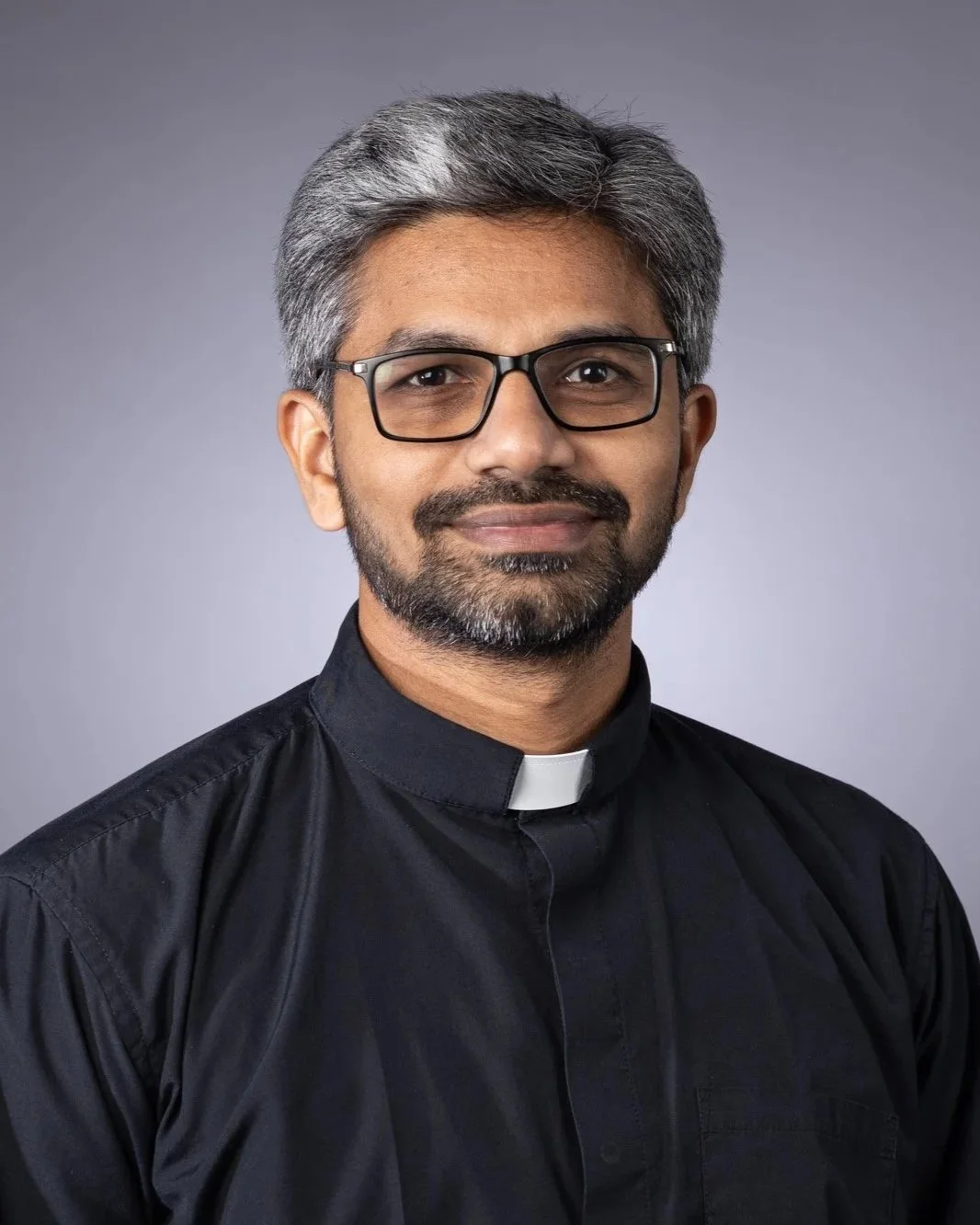
Fr. Rajesh Somepalli, SJ
From Patna to the Midwest
Fr. Rajesh Somepalli, SJ, from the Patna Province, reflects on the Midwest Province’s relationship with Patna and the time he spent working at Saint Ignatius High School in Cleveland. Currently, Fr. Somepalli is studying for a PhD in education at Marquette University in Milwaukee. His dissertation will look at the impact of digital communication on education in North India with a focus on the most socially marginalized groups in the state of Bihar.
My time in Cleveland was a gift, a manifestation of God’s love poured into the hearts of the people there and shared with me without any condition. Living at Saint Ignatius High School was a humbling experience, walking those same grounds as the Jesuit missionaries who gave their all for the people of Patna and Nepal. The people of Cleveland welcomed me with open arms, and their love and prayers continue to sustain me. Offering Masses at Ennis Court and Saint Ignatius High School was another rejuvenating experience, strengthening me spiritually, emotionally and academically.
As I see it, the connection with the Midwest Province is a source of inspiration and gratitude for all Patna Jesuits. After a period of time, we’re reconnecting and rediscovering the bond that was forged by our forefathers. We’re thankful for the constant support, prayers and interest of Midwest Jesuits in the Patna mission, and we look forward to deepening our relationship through mutual visits and collaboration. We’re grateful for the legacy of service and sacrifice that we inherit, and we’re committed to continuing their work, inspired by the same spirit of generosity and love.