
This fall, the Center for Ignatian Pedagogy (CIP) at Saint Ignatius High School in Cleveland will host a symposium for teachers and administrators across the Catholic Diocese of Cleveland to share best practices and policies related to artificial intelligence (AI) in schools.
“We are laser focused on the question, ‘How do our decisions position us to amplify our mission and facilitate exceptional, deep teaching and learning alongside faith-aligned character formation?’” says Dr. Terra Caputo, director of the CIP.
AI technology poses multiple challenges to educators and students alike, challenges that can undermine the rigorous Jesuit model of education. Shortcuts have never been part of the Jesuit tradition. “Our schools are devoted to giving students the opportunity to think deeply about what they are consuming, to deconstruct it, and to pray and reflect about it,” says Jen LaMaster, the Midwest Province’s provincial assistant for secondary and presecondary education.
But AI can also improve classroom experiences, and Jesuit schools are embracing that technology for the benefit of their students. “AI can create iterations of multiple variables and virtual labs that would otherwise be impossible in high school, like the ability to do a subzero lab,” LaMaster says. “A good number of our high schools have animation classes, where they’re doing storyline and character development and coding and visual effects. AI helps do some of those things that were super complex 20 years ago.”
Teachers at Jesuit schools have begun utilizing AI in lesson planning and to guard against shortfalls in education when students attempt to use AI to circumvent the process of learning. For example, most schools in the Midwest Province are Google schools, which means teachers are able to see draft histories of writing assignments.
At Brebeuf Jesuit Preparatory School (BJPS) in Indianapolis, faculty and staff use Google NotebookLM and other AI tools to curate study guides and other resources for their students. With funds from a recent $12 million grant from the Lilly Endowment Inc., BJPS plans to build an AI innovation center. “We’ll use the grant to develop tools and curriculum for teachers and students,” says Pam Malone, the school’s educational technology director. (For more on the grant and Brebeuf’s plans, see “Brebeuf Jesuit’s $12 Million Endowment Grant,”page 17.)
At St. John’s Jesuit High School and Academy (SJJ) in Toledo, Ohio, teachers are encouraged to integrate AI into their lesson plans, including an 8th grade project in which students use AI to build conceptual structures of career paths that interest them.
SJJ Principal Steve Spenthoff keeps parents informed and in dialogue about the latest approaches to AI use in the classroom.
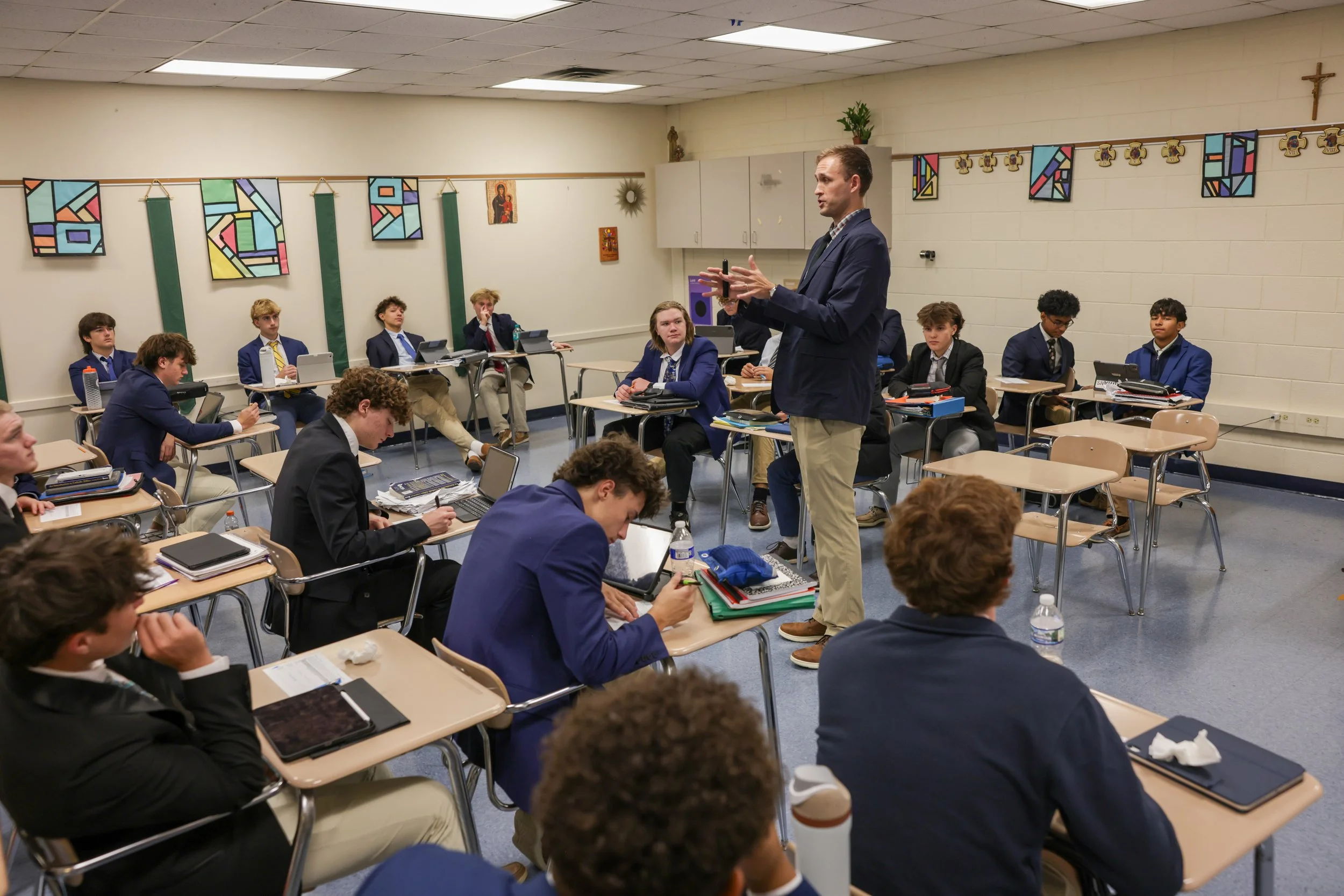
Theology teacher Phil Levering conducts a lecture at St John’s Jesuit High School and Academy in Toledo, Ohio.
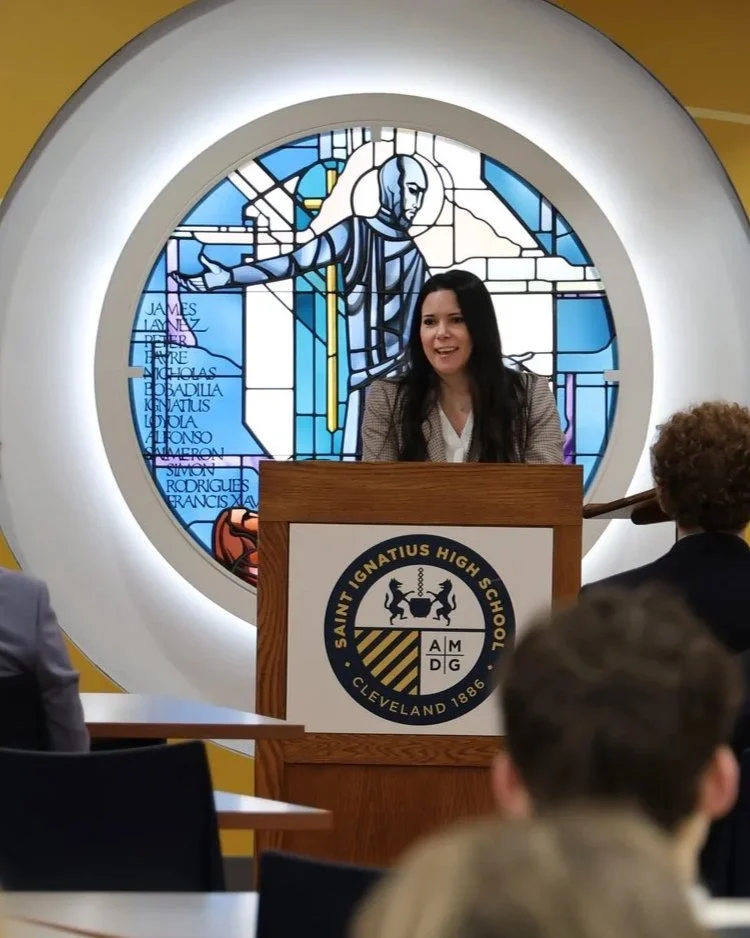
Dr. Terra Caputo addresses a student research symposium on artificial intelligence at Saint Ignatius High School in Cleveland.
I THINK WE NEED TO BE PROPHETIC IN ARTICULATING OUR VISION OF WHO OUR STUDENTS ARE MEANT TO BECOME AND, WITH THIS VISION IN MIND, DISCERN HOW TO USE THE TOOLS AND RESOURCES WE HAVE AT OUR DISPOSAL.
He also credits the Jesuit Schools Network for providing opportunities to collaborate on best practices through professional development and Zoom conferences.
The school has created a technology committee that provides AI guardrails and explores its future potential. Sean Wheelock, and an SJJ alumnus (’13), has developed an AI app that helps students at his alma mater address mental health issues. “Information provided to the AI-driven app will help bridge the student to speak with a counselor to deal with their emotional well being,” Spenthoff says.
In the coming years, Ignatian pedagogical thought promises to influence best practices in AI at all levels of Jesuit education.
“I think we need to be prophetic in articulating our vision of who our students are meant to become and, with this vision in mind, discern how to use the tools and resources we have at our disposal,” says Marquette University (MU) Theology Chair Fr. Ryan Duns, SJ.
As an administrator, Fr. Duns uses AI to synthesize large amounts of data. As a teacher, he uses it to design templates and activities that augment student experience.
“My guiding principle has been the First Principle and Foundation of the Spiritual Exercises,” Fr. Duns says. “The human person is created to praise, reverence and serve God our Lord, and by doing so to save his or her soul. The person has to use these things insofar as they help toward this end, and to be free of them insofar as they stand in the way of it.”
The Jesuit Universal Apostolic Preferences (UAPs)—Showing the way to God, Walking with the Excluded, Journeying with Youth and Caring for Our Common Home—are a “critical touchpoint” in discerning best practices for AI use, says Dr. Caputo of the CIP.
“How do we engage with AI in ways that allow us to accompany youth into a hope-filled future while also caring for our common home?” she says.
At BJPS, Malone prepares for ever-evolving adjustments to AI.
“The school is absolutely aware that future guidelines will have to think deeply about what it means to be a human person with inherent dignity and how AI can challenge the full development of that human,” Malone says. “Educators have a sacred responsibility to make sure this is not the result.”
While Jesuit schools carefully limit the role of AI in classrooms, Fr. Duns reminds us to respect the power of human imagination.
“AI can use only what is given,” Fr. Duns says. “The human imagination exercises itself by envisioning what could be. I am more and more convinced that the best thing we can do for our students is teach them how to tell a story. Learning this skill, learning to communicate well and clearly, will likely set them apart from others who rely on machines to think for them.”