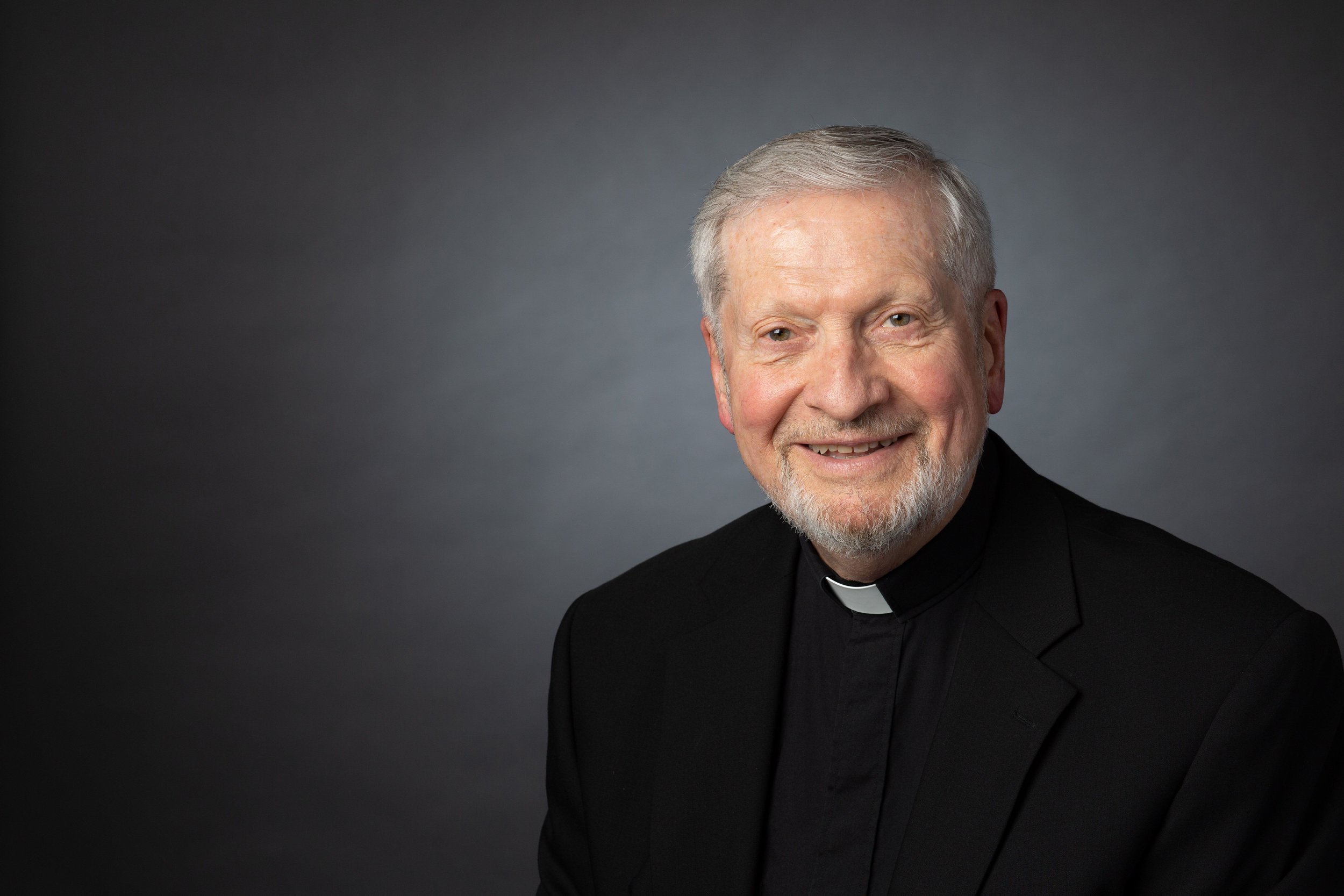

Fr. David Schultenover, SJ, had to decide whether to become a priest/organic chemist or a priest/theologian.
By Amy Korpi
Fr. David Schultenover, SJ, reflects on events that led him to his vocation
As early as age 12, Fr. David Schultenover, SJ, felt called to the priesthood.
“A Columban missionary came to talk to us at Sacred Heart Grade School [in Sauk Rapids, Minn.] and screened a movie of his work on an Asian island,” Fr. Schultenover says. “Thereafter, becoming a priest was always in the back of my mind.”
It would be a few years before he chose the “brand” of priest he would become. He was uninterested in the diocesan path or the monastic life. Then, at Cathedral High School in St. Cloud, Minn., he met a student who had been expelled from Campion Jesuit High School in Prairie du Chien, Wis. “It was from him that I learned the Jesuits were a religious order of priests and brothers who run schools,” he says.
Having always enjoyed learning, young David thought that teaching and working with students would suit his personality and allow him to conjoin a priestly vocation to an academic one. But it took his Latin teacher’s intercession to bring the idea to life.
“In my senior year, between football and basketball seasons—I played all sports—Sr. Angelo required me to make up time after school for fooling around in her class,” he says. “Her real motive was to ask whether I planned to be a priest. I couldn’t imagine how she came up with this question because I was a troublemaker, and I had been keeping my vocational intentions quiet so as not to interfere with my social life.”
Nevertheless, he admitted it was so, and she asked which path he was considering.
“Suddenly, the memory of the Campion student bubbled up,” he says.
When Sr. Angelo heard that young David might join the Jesuits, she offered to make some contacts and gather some information for him.
The serendipitous events in Fr. Schultenover’s life continued. During his Jesuit formation, with a bachelor’s and master’s degree in chemistry, he taught high school chemistry and neared completion of a PhD program in organic chemistry. Then he read the newly released Documents of Vatican II.

Amy Korpi, a freelance writer with two degrees from Marquette University, is based in Green Bay, Wis. She has been working with the Jesuits since 1998.
“These documents excited me as no other text I had ever studied,” Fr. Schultenover says. “I delved into them and found my imagination lit up with possible implications for both the Church and me. So, after the first of the four years of theology that every Jesuit takes if he’s preparing for ordination, I faced a question I could not avoid: What does the Church I am called to serve need more at this time in history, a priest/organic chemist or a priest/theologian?”
He discussed the question with his provincial superior.
The result: He began pursuing a PhD in theology.
In the years to come, he would teach in that field, first at Creighton University in Omaha and then at Marquette University in Milwaukee, where he held the position of Henri de Lubac Professor of Historical Theology and served as editor of the scholarly journal Theological Studies.
“Vatican II profoundly changed the Catholic Church’s posture toward itself and the world,” he says. “I knew it would take me years to explore all that excited me both about the documents and the historical theology that came out of that Council and theology in a historical context. In the process, Vatican II and consequent ecumenical and inter-religious dialogue profoundly changed both the Catholic Church and non-Catholic churches—and my life—in profound ways.”