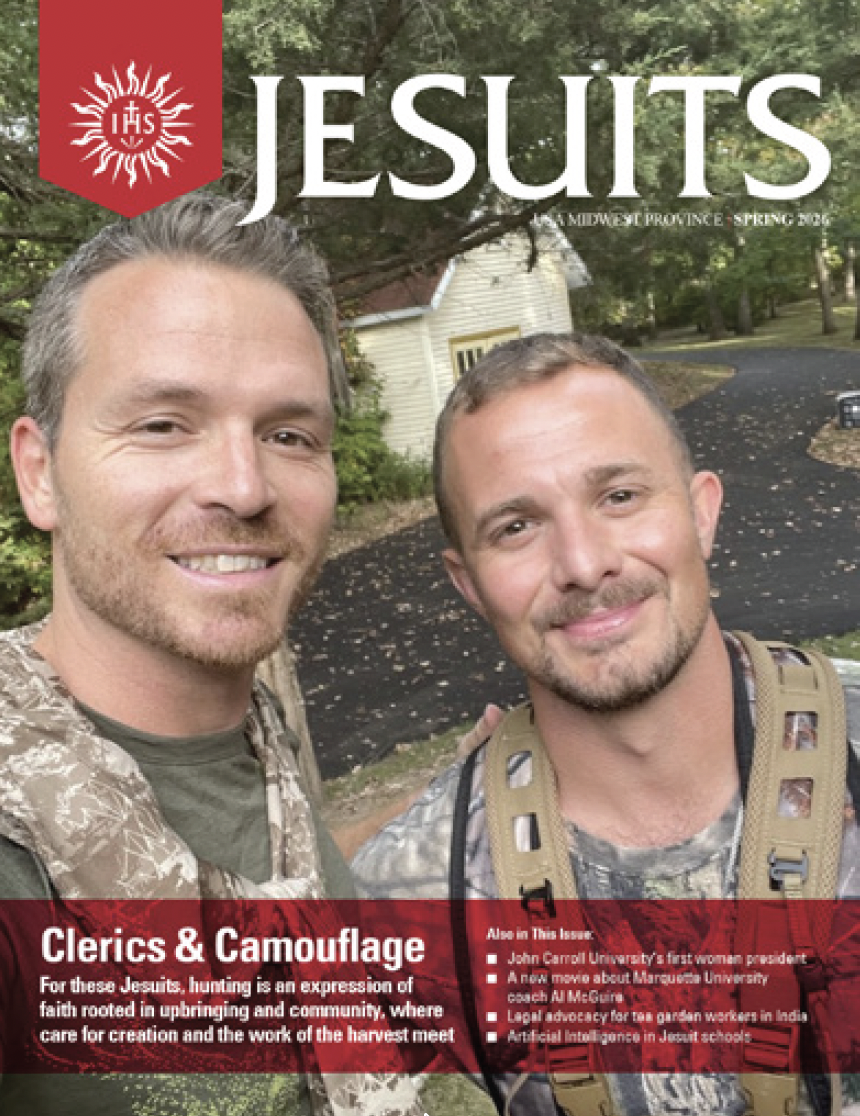


Jesuits (from left) Michael Pederson, Ben Rogers and Br. Mark Mackey with a recently harvested deer in Wisconsin.
By Andrew McKernin
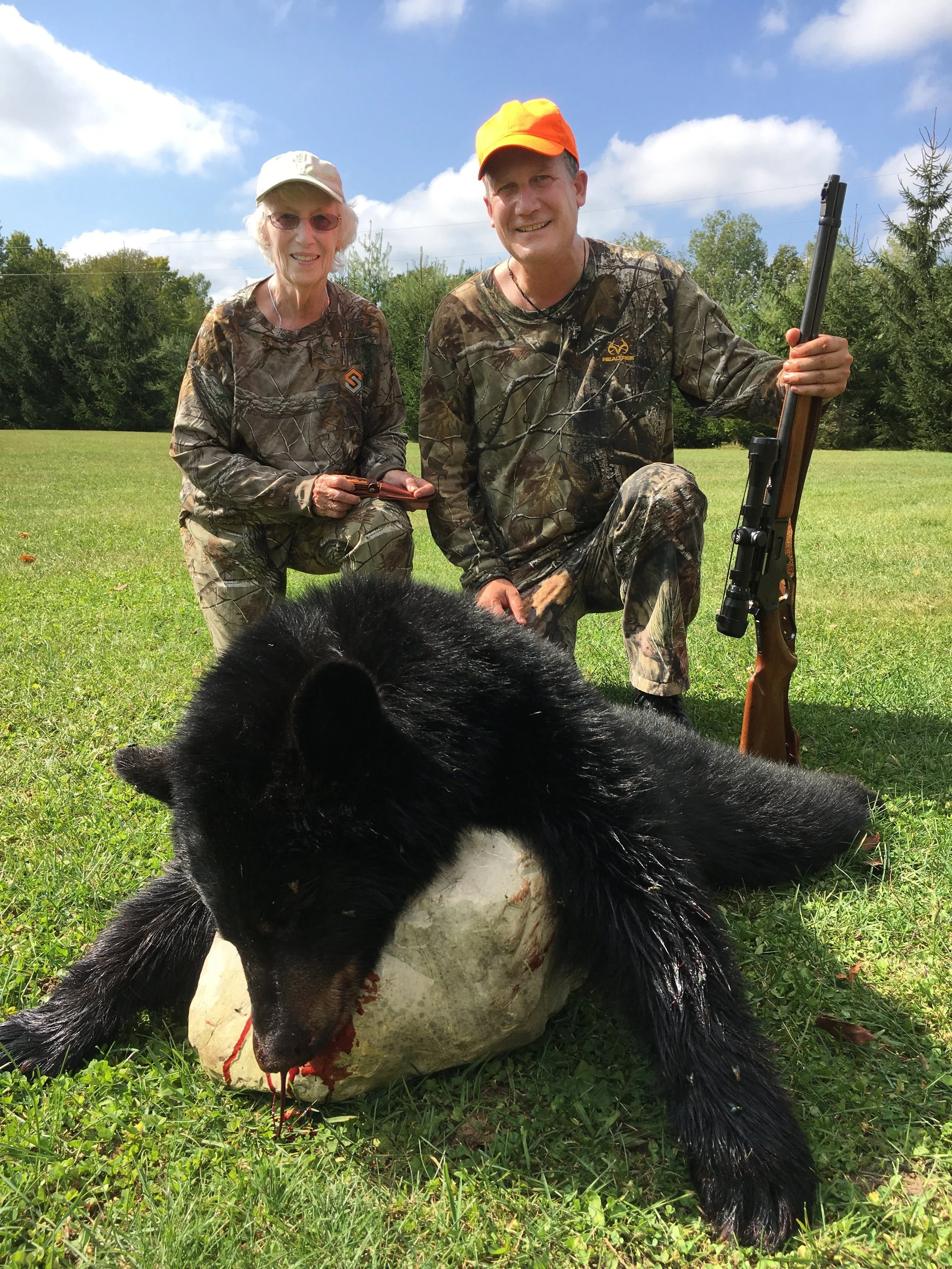
Patty Boynton and her son, Br. Jim Boynton, SJ, with a black bear they harvested in the Upper Peninsula of Michigan. When Br. Boynton was a boy, his mother sometimes sent him out to “catch dinner.”
To see God in the natural world and connect with all living things, Midwest Jesuits lean into their lifelong love of hunting
Growing up in Michigan’s Upper Peninsula, Br. Jim Boynton, SJ, had chores just like any other kid. But in his hometown of St. Ignace, dotted with small lakes, expansive forests and the freedom to roam, it wasn’t always about cutting the grass and taking out the garbage.
“Sometimes my chore was, ‘Catch dinner,’” Br. Boynton says with a laugh. In the Boynton household, hunting wasn’t just a hobby, it was a way of life.
This is why he, and a small brotherhood of Midwest Jesuits, continue to hunt to this day. It is in their blood. It informs who they are. They are men who find God not only in quiet chapels, but in the rustle of autumn leaves, in the rising sun that replaces the dark with light. In the shock of cold air on the cheeks.
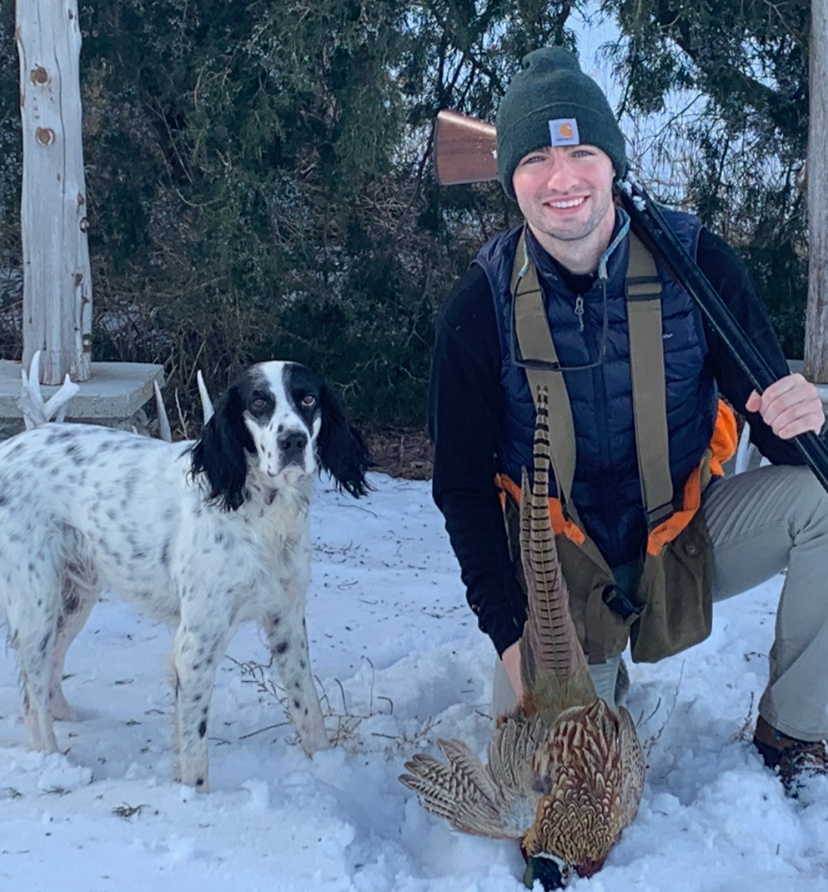
Ben Rogers, SJ, and his English setter, Abe, at the Rogers family farm in South Dakota.
Michael Pederson, SJ, a scholastic with master’s degrees in both philosophy and environmental science and sustainability, recalls mid-December in Iowa, frost covering the corn fields like white velvet. At age 14, he joined his family’s annual deer hunt for the first time, and the thrill has never left him.
Ben Rogers, SJ, who pronounced first vows in 2023, grew up in South Dakota, where pheasant season rivaled Christmas for excitement. Brother Mark Mackey, SJ, an Ohio native and ecologist at the Loyola University Chicago (LUC) School of Environmental Sustainability, cherished retreating to the woods outside his grandfather’s cabin long before he understood how spiritually rich the silence of nature could be.
But hunting involves more than just walking through nature, more than just sitting quietly in tree stands and listening to forests come alive in the morning or begin to settle in for the evening.
“Hunting is hard,” Rogers says. “It’s hard to take the life of an animal that may have known freedom better than you or I.”
The reverence continues long after the harvest for these hunters, and no animal dies in vain. The men process the animals themselves, saving every ounce of meat. Roasts, steaks, sausages and jerky are shared widely and joyfully.
Brother Boynton, the president of University of Detroit Jesuit High School and Academy, cooks for his Jesuit community, offers wild game dinners for student auctions and prepares venison for the maintenance staff.
Pederson recently grilled 10 pounds of venison backstrap for 25 Jesuit community members and led a talk on the intricacies of bowhunting. You have to read the land and know the food sources, he said. You have to pay attention to the seasons, the acorn supply, the deer behavior, the intimacies of the ecosystem.
“A successful hunt isn’t always about getting an animal,” he says. “It’s about the time out there.”
EVERY SQUARE INCH OF NATURE IS ALIVE. IF YOU PAUSE LONG ENOUGH, YOU’LL SEE IT COME TO LIFE. YOU’LL SEE GOD.
Put another way, hunting is spiritual, filled with silence and waiting, and the humility of the hunter’s knowing that he is a guest in creation, not its master. “Every square inch of nature is alive,” Br. Boynton says. “If you pause long enough, you’ll see it come to life. You’ll see God.”
What may look unusual from the outside— Jesuits hunting animals—becomes deeply human when it is considered up-close. Brother Mackey sees it as a way of practicing what he teaches in his Eco-Spirituality class at LUC, remembering that humans are not separate from the food web but a part of it.
Each year, the class shares a potluck meal featuring venison from a deer Br. Mackey harvested the previous season. They discuss the way their diet clearly connects them to the rest of creation.
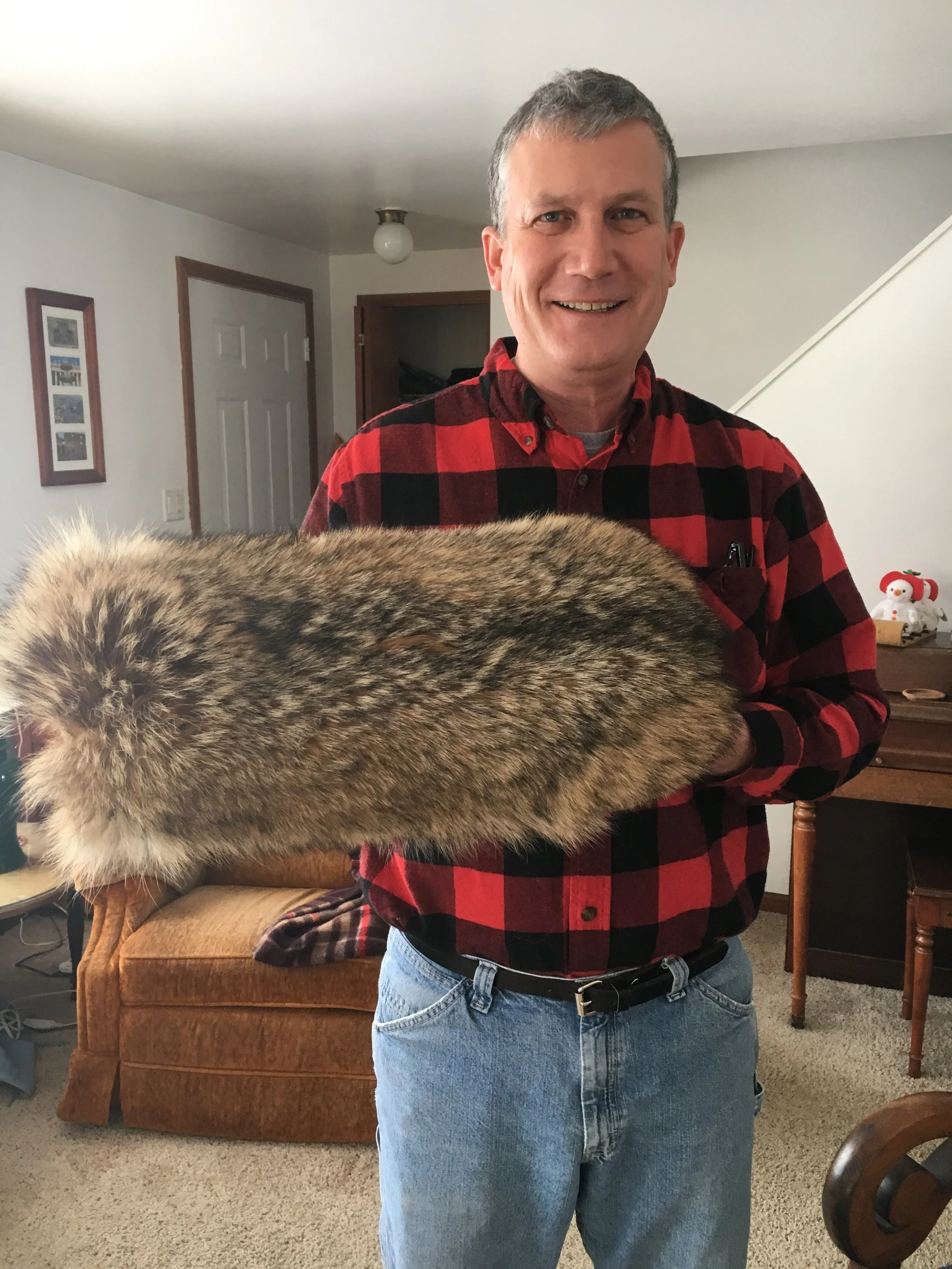
Brother Jim Boynton, SJ, turns hides into pillows, pouches, purses and artwork—reminders that an animal’s gifts do not end at the table.
“Whether one eats a vegan or meat diet, having a relationship with one’s food source and having an active hand in its harvesting can be a deep sign of respect and reminder of our interconnectedness,” Br. Mackey says.
Ecologically speaking, hunting is net-positive, as license fees and habitat restoration led by hunters are among the largest drivers of conservation in the United States. Hunting is also a lived expression of Pope Francis’ encyclical Laudato Si’ and one of the four Jesuit Universal Apostolic Preferences, Caring for our Common Home. Wild animals live freely and die swiftly at the hands of hunters, creating a more honest connection between land, life and table than any grocery store could offer.
For six years, Pederson sourced the meat he consumed entirely from animals he harvested. Today, he makes a conscious effort to eat ethically sourced animal protein, as does Br. Mackey.
Even the animals’ remains become a part of the story for these Jesuits. Brother Boynton turns hides into pillows, pouches, purses and artwork—reminders that an animal’s gifts do not end at the table. Rogers saves pheasant feathers and ties his own fishing flies with them, carrying the bird’s beauty from field to stream. Every step, from waiting in the pre-dawn darkness to sharing an evening meal, is an expression of gratitude and respect.
The land is treated with just as much reverence. To attract pheasants, the Rogers family restored some of its South Dakota cropland to native prairie. Soon, sharp-tailed grouse, bobwhite quail and wildflowers returned, far beyond their original hopes. Now, on visits home, Rogers loves walking through tall grass with his English setter, Abe, as the sun drops low and gold.
“When I’m still and silent, that’s when God comes into my life and I feel most alive,” he says.
Early in their formation, Rogers and Br. Mackey worried that hunting might not be compatible with Jesuit life. To their surprise, they found brothers who loved the outdoors as much as they did, Jesuits who never had to abandon the parts of themselves that felt most natural.
“It confirmed that I’d taken the right path,” Rogers says. “God delights in us being fully ourselves.”
A member of the Sault Ste. Marie Tribe of Chippewa Indians, Br. Boynton hunts on an Indian license and incorporates Indigenous practices, including prayer and the offering of tobacco, thanking the animal’s spirit.
His mother Patty, who used to send him out to bring home dinner, is 87 now and still joins him on hunts in the Upper Peninsula. He and his lifelong friend Danny Gillespie also still make the trek to Beaver Island in Lake Michigan, 32 miles from the mainland, for an annual deer hunt. They and others spend a joyous week filled with music, storytelling and just enough hunting. It is as much about friendship and a love of nature as it is about anything else.
Jesuits with bows may surprise us at first. But perhaps the surprise says more about our assumptions than their lives. Hunting is a way for them to live gratefully within creation, to listen for God in the silence. They step into the woods not to withdraw from the world, but to remember their place within it.